Showing posts with label medical wonders. Show all posts

Saturday, January 8, 2011

Trauma Cited in Mysterious Ark. Bird Kill

USA Today - A mysterious event that caused thousands of red-wing blackbirds to rain down from the sky New Year's Eve in the Arkansas town of Beebe may have occurred when loud noises or fireworks frightened a flock that roosts in a neighborhood, causing them to fly into buildings and other obstacles, a state ornithologist said.

But others still think weather could have played a role.

Preliminary necropsies on the dead birds by the state Livestock and Poultry Commission "showed trauma," said Karen Rowe, Arkansas Game and Fish Commission ornithologist. "The birds obviously hit something very hard and had hemorrhages." Beyond that, all the birds were healthy.

The state is also performing chemical and disease testing, but the results will take a week.

Neighbors reported five to 12 booming noises in the eastern part of Beebe, a community of 5,000 northeast of Little Rock. "They reported it sounding like a cannon or transformer exploding," but officials are still investigating to find out what the noises were, Rowe said.

The flock then rose from its roost and tried to fly away, but possibly because of fireworks in the sky "they naturally wouldn't want to go up high," she said. "They were below the roof line, so they were hitting houses, mail boxes, chimneys and walls."

Blackbirds have very poor night vision.

The first calls about the incident came in at about 11 p.m. on New Year's Eve, according to Keith Stephens, with the Game and Fish Commission.

"They told us there were birds falling out of the sky. After we verified that this wasn't some kind of prank, one of our wildlife officers went over there and sure enough, there were birds falling," he said.

The Department of Emergency Management tested the air and found nothing amiss, so the state isn't putting out any health warnings, he said.

Many theories being floated about causes of the die off can be discounted, said Dan Cristol, a professor of biology at the Institute for Integrative Bird Behavior Studies at the College of William & Mary in Virginia. The birds couldn't have eaten a fast-acting pesticide because they would have eaten it during the day and died long before they began to roost at night, he said. A slower-acting pesticide wouldn't have affected them all at the same time. A hail storm is unlikely because they would have had to be flying for that to happen, and at that hour red-wing blackbirds are asleep.

Rough weather had hit the state earlier Friday, but the worst of it was well east of Beebe by the time the birds started falling, said Chris Buonanno, a forecaster with the National Weather Service in North Little Rock.

But one expert said he can't discount weather as a cause.

"Thousands of birds encountered something, whether it was a lighting strike or hail or something, and that caused the trauma and death," said Robert Meese, an avian ecologist at the University of California-Davis. "I don't see any way that they could have flown into obstructions, because then the birds should have been at the base of the objects. ... This was a scattering."

The number of dead blackbirds is more than 3,000, Rowe said. "Environmental Services says they picked up approximately 2,000 birds." There were others they couldn't reach, she said, and "scavengers probably carried off quite a bit — if you're a cat, it's Christmas dinner."

Red-wing blackbirds are native to North America and gather in large flocks in the winter, generally settling near food sources for weeks at a time, said Mike Parr of the American Bird Conservancy in Washington, D.C.

The number of birds that died Friday is high, he noted, but "to put the number in perspective, windows, communication towers, power lines and wind turbines kill tens of millions of birds each year, probably hundreds of millions."

In an unrelated event, a major fish kill was reported on the Arkansas River last week, Stephens said. Approximately 80,000 to 100,000 dead freshwater drum were found along a 17-mile stretch of the river, about 100 miles from Beebe, between the Ozark Lock and Dam and a point due south of Hartman.

State officials believe the fish kill was disease related. Specimens have been sent to state labs for testing.

The incidents — coming during a traditionally slow news period — made for a wild weekend for state Game and Fish staffers.

"It's the craziest thing I've ever experienced and I've been doing this for 25 years," Stephens said. "I'll bet you I've had 100 calls today, I've done 25 interviews. I did Al-Jazeera live last night."

Friday, February 5, 2010

Vegetative State Doesn't Mean Brain Death

Food Consumer.org- Some patients diagnosed as being in a vegetative state may be fully aware of what's going on around him, a new study in the New England Journal of Medicine suggests.

The study led by researchers in England and Belgium found four of 23 vegetative patients had signs of consciousness on brain-imaging tests.
For the study, Adrian M. Owen, coauthor, at the Medical Research Council in the U.K. and colleagues used functional magnetic resonance imaging or fMRI to test 54 patients with severe brain injury and see if they could think.

Patients were placed in a MRI scanner and asked to imagine playing tennis, which would activate the part of the brain associated with movement if the patients responded and asked to imagine walking on familiar city sweets, which would activate the part of the brain linked to spatial navigation if they were responsive.

Based on the test results, the researchers determined four out of 23 patients diagnosed as being in a vegetative state actually answered the questions the researchers asked just like the health control subjects did.

They further tested the patients asking them if they had brothers. The study subjects were asked to imagine playing tennis if the answer was yes and to imagine walking around their houses if the answer was no.

The four vegetative patients responded to the question correctly.

Forty percent of patients who suffered severe brain injury were misdiagnosed, according to the researchers and this misdiagnoses could lead to a wrongful termination of a patient's life.

Wednesday, December 23, 2009

Eww...The Cow That Would NOT Die..

Stuff.co.nz- "A prominent central North Island farmer and his farm manager have been found guilty of ill treating a cow, which was shot and then impaled still alive on a tractor fork... Frew said he was horrified when he removed the cow from the forks and it stood up and staggered off to join a herd of cattle nearby. The cow was shot again but refused to die." (Read article)

Friday, December 18, 2009

Baby Missing Brain Turns One


Nicholas Coke, the baby born with only a brain stem, reached his first birthday.
Click video to hear more.. Very sad..

Saturday, September 5, 2009

Teen Who Cries Blood Gets Help From Experts

(CNN) -- Calvino Inman had just stepped out of the shower one evening in May when a glimpse of his reflection in the mirror caused him to panic. "I looked up and saw myself, and I thought I was going to die," says the 15-year-old from Rockwood, Tennessee. His eyes were streaming tears of blood.

Inman's mother, Tammy Mynatt, says she immediately rushed him to the emergency room, but by the time they arrived, the bleeding had stopped. Doctors couldn't see what the family was trying to explain. They returned home completely perplexed. When the bloody tears returned a few days later while Inman was on a camping trip, he was rushed back to the hospital.

Mynatt hoped that once doctors finally witnessed the phenomenon, there would be answers. But that wasn't the case. "The people at the hospital said they had never seen anything like it," Mynatt recalls. She says her son underwent an MRI, a CT scan and an ultrasound, but none of the tests had abnormal results. "'We don't know how to stop it,'" Mynatt remembers being told by doctors. "It just has to run its course."

Dr. Barrett G. Haik, director of the University of Tennessee's Hamilton Eye Institute, says there is an answer, sort of. He says "crying blood," a condition called haemolacria, is common in people who have experienced extreme trauma or who have recently had a serious head injury. But a case such as Inman's is still a medical mystery. "What's really rare is to have a child like this," Haik says. "Only once every several years do you see someone with no obvious cause."

Haik and a team of researchers published a 2004 study in the Journal of the American Society of Ophthalmic Plastic and Reconstructive Surgery looking specifically at children who developed unexplained, spontaneous episodes of bloody tears between February 1992 and January 2003. Only four cases were recorded.

Because of the rarity of the condition, experts anticipate Inman will have multiple tests from a variety of specialists, including hematologists (blood specialists), ophthalmologists (eye specialists) and otolaryngologists (ear, nose and throat specialists).

Dr. James C. Flemming, also an ophthalmologist at the Hamilton Eye Institute, has been in touch with Mynatt and her son. He is reviewing Inman's medical records for possible treatment.

Flemming says complications to look for include blood clots, a growth or tumor near the eye, or even a simple infection. He also says the culprit could be something so tiny that none of the standard tests would pick it up. "It's a very hard thing to estimate," Flemming says. "You may have to watch expectedly for other symptoms to show up."

Inman's analysis would also include a psychological evaluation to rule out the possibility that the bloody tears were faked. "When you can't find an origin, you can't eliminate any of the possibilities" Haik explains. He says there have been cases where children seeking attention have found creative ways to simulate haemolacriatic symptoms.

Still, Mynatt and her son are relieved to at least have more guidance. In an interview with CNN affiliate WATE, Mynatt was near tears herself explaining her frustration: "I just truly want somebody to say they've seen this and they can help us."

And that's at least one reassurance Flemming and his team of experts at the Hamilton Eye Institute can offer. "We get more positive talk now than negative. It really feels like there's hope," Mynatt says, relieved.

But still, the possibility remains that after endless tests, the underlying cause may never be found. In all four cases Haik examined previously, the bleeding stopped on its own.

"As physicians, that's disconcerting, because we like to have the answers," Haik admits. Moreover, he says he knows from previous experience that the toll of not knowing is much worse for patients. "I could always see the fear in their faces because no matter what we studied, we couldn't find an answer."

Thursday, June 25, 2009

Doctors Baffled, Intrigued by Girl Who Doesn't Age

ABC News- Brooke Greenberg is the size of an infant, with the mental capacity of a toddler.
She turned 16 in January.


"Why doesn't she age?" Howard Greenberg, 52, asked of his daughter. "Is she the fountain of youth?"

Such questions are why scientists are fascinated by Brooke. Among the many documented instances of children who fail to grow or develop in some way, Brooke's case may be unique, according to her doctor, Johns Hopkins School of Medicine pediatrician Lawrence Pakula, in Baltimore.

"Many of the best-known names in medicine, in their experience ... had not seen anyone who matched up to Brooke," Pakula said. "She is always a surprise."

Brooke hasn't aged in the conventional sense. Dr. Richard Walker of the University of South Florida College of Medicine, in Tampa, says Brooke's body is not developing as a coordinated unit, but as independent parts that are out of sync. She has never been diagnosed with any known genetic syndrome or chromosomal abnormality that would help explain why.

In a recent paper for the journal "Mechanisms of Ageing and Development," Walker and his co-authors, who include Pakula and All Children's Hospital (St. Petersburg, Fla.) geneticist Maxine Sutcliffe chronicled a baffling range of inconsistencies in Brooke's aging process. She still has baby teeth at 16, for instance. And her bone age is estimated to be more like 10 years old.

"There've been very minimal changes in Brooke's brain," Walker said. "Various parts of her body, rather than all being at the same stage, seem to be disconnected."

Brooke's mother, Melanie Greenberg, 48, sees a different picture. "She loves to shop," Greenberg said. "Just like a woman."

Brooke rides in a stroller while her mom shops for clothes in the infant sections of department stores near their home in a Baltimore suburb. That Brooke is in her mid-teens is so mind-boggling that if another mother with a toddler asks Greenberg how old Brooke is, she usually doesn't try to explain.

"My system always has been to turn years into months," Greenberg said. "So, if someone asked today, I might say, she's 16 months old."

CLICK HERE to see photos of Brooke through the years.

Watch "20/20" FRIDAY at 10 p.m. ET for Brooke's story.

Friday, June 5, 2009

Triplet Gives Birth to Her Own Set of 3

DETROIT (June 4) - A Michigan woman who's one-third of a set of triplets is celebrating the birth of her own three babies.

Amber Ali delivered Amir, Armann and Amari Whitaker on May 26 at Sinai-Grace Hospital in Detroit. The 23-year-old woman tells The Detroit News she's relieved the boys arrived safely.

The children remain hospitalized, and Ali says she's looking forward to playing with them. She says: "It's going to be fun."

Amir was 4 pounds, 5 ounces at birth; Amari was 4 pounds, 3 ounces; and Armann was 3 pounds, 12 ounces. The babies' 25-year-old father, Andre Whitaker, says that naming the triplets "took forever."

Whitaker said he was shocked when he first learned Ali was carrying triplets. "Tell you the truth I almost passed out," he told Local 4 television station in Detroit.
The couple live with Whitaker's mother in Detroit. Amber Ali's triplet sisters, Asia and Ashley, live in nearby Redford Township.

Tuesday, May 5, 2009

U.S. Face Transplant Recipient Offers Thanks

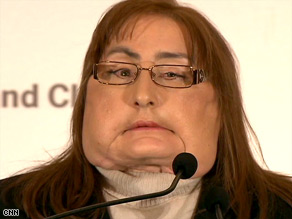
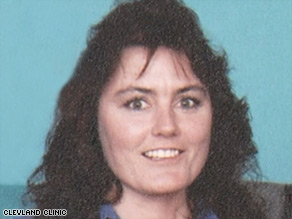
(CNN) -- In 2004, a bullet ripped away Connie Culp's nose, cheeks and upper jaw. Metal fragments sprayed into her skull and stripped her face away, leaving nothing except for her eyes, her chin and forehead.

Without her nose, she could not smell. She breathed through a tracheostomy -- a surgical opening in her neck. Without lips, she could barely speak.

But Tuesday, when Culp, 46, the first recipient of a face transplant in the United States, stepped in front of the cameras at a news conference, she was whole.

In a soft voice, the Ohio mother of two repeatedly thanked the medical staff and the deceased donor whose nose, upper lip, cheekbones are now hers.

"I want to focus on the donor family that allowed me to have this Christmas present," she told reporters gathered at the Cleveland Clinic, where her surgery took place.

In December, Culp underwent a 22-hour transplant surgery. Although the hospital announced the facial transplant at that time, the patient had remained anonymous until the news conference.

During the surgery, tissue from a deceased donor's face was shaped and fitted into position. Multiple layers of tissue, bone, muscle and blood vessels, nerve grafts and each artery and vein were connected. Culp received a nose, lower eyelids and upper lips, as doctors filled in the missing components of her face.

Culp could not yet move her facial muscles to form a smile, but she laughed.

"Well, I got me my nose." she quipped.

Two months after the surgery, Culp was discharged from the hospital and returned home. Before the surgery, Culp could not eat solid foods. She could not taste.

"Connie can now enjoy her food," said Dr. Maria Siemionow, who led the transplant operation. "She eats hamburgers and enjoys her pizzas, she's drinking coffee from the cup."

Her new face allows her to "blend with society."

"As you can see we have now a healthy person and happy person," Siemionow said. "She has reduced dramatically her pain and also she's able to walk on the street without being called names."

Since the operation, doctors say Culp's new face has developed more movement. The new facial nerves are growing slowly, about an inch a month.

"While Connie can do several things now that she was unable to do in the past, as time goes on more and more of the facial nerves will grow," said Dr. Frank Papay, chairman of the Dermatology and Plastic Surgery Institute at the Cleveland Clinic. "She will become more animated."

For years, Culp lived "in tremendous pain, chronic pain, over the entire time," said Siemionow, director of plastic face transplant surgery research and head of microsurgery training at the hospital.

Culp told a local television station in a 2008 interview that she had been shot in the face from just eight feet away in an attempted murder-suicide by her husband.

In 2005, Culp came to the Cleveland Clinic for treatment. After 30 surgical procedures, none had restored her basic functions.

"The last resort and the last option was to consider face transplantation," said Siemionow. Transplant recipients have to take immunosuppressing, anti-rejection drugs for the rest of their life.

After the hospital's surgeons, ethical committee members, psychiatry and psychology specialists met with Culp, they decided "that Connie is the right patient," Siemionow said.

Doctors involved in Culp's treatment said the surgery was not about aesthetics, but to restore Culp's basic abilities.

"We are actually overwhelmed by how great she's doing functionally," Siemionow said. "And I'm re-emphasizing that this is all about functional outcome. Someone who couldn't breathe through the nose, who couldn't eat solid foods, didn't have a palate or not able to drink from a cup. ... So if she can do all these functions that are taken for granted on a daily basis, this is amazing."

Although there is a risk Culp's body could still reject the transplant, the doctors said they have not seen such signs.

Some critics say face transplants are unnecessary, because they are risky procedures involving a lifetime of immunosuppressants, that do not save a person's life, but improve an individual's appearance. Previous face transplants performed in Europe and Asia generated controversy. A Chinese man whose face was disfigured in a bear attack died of unknown causes two years after receiving the face transplant.

The fact that Culp regained some of her basic functions highlights that "this is not cosmetic surgery in any sense of the word," said Dr. Eric Kodish, the professor and chairman of the Cleveland Clinic's Department of Bioethics. "We remain convinced about the ethical justification for the face transplant in this and potentially in other cases in the future."

Ultimately, the face transplant affords an individual's "right to decide what kind of life they want to live." Many with facial disfigurements are called names, can't go out in public or wear masks to hide their face, said Siemionow.

In Culp's case, it was a matter of restoring basic physical abilities.

"If you can breathe through your nose in the spring in Cleveland, isn't that amazing?" said Siemionow.

Culp will require a few more cosmetic procedures, for example to remove excess skin from her face.

Culp read a statement and did not take questions. She told reporters in the news conference that she had been shot and said, "I don't want to go into it."

Then she asked the public to have empathy for people with facial disfigurements.

"When somebody don't look as pretty as you do, don't judge them," she said. "You don't know what might happen to you. Don't judge the people who don't look the same way as you do. You never know when it may be taken away from you."

Sunday, May 3, 2009

Introducing: The World's Oldest Conjoined Twins!

Tonight on TLC:
"World's Oldest Conjoined Twins"


This documentary series follows the lives of 57 year-old Ronnie and Donnie Galyon, two conjoined twins who return to a normal life after working in carnival circuits for forty years.

The brothers work together to accomplish ordinary routines in extraordinary ways.