Showing posts with label pandemics. Show all posts

Thursday, June 11, 2009

WHO Declares Swine Flu Pandemic

(CNN) -- The World Health Organization raised the swine flu alert Thursday to its highest level, saying H1N1 has spread to enough countries to be considered a global pandemic.

Increasing the alert to Level 6 does not mean that the disease is deadlier or more dangerous than before, just that it has spread to more countries, the WHO said.

As of Wednesday evening, the virus had spread to 72 countries, the health agency said. There were 25,288 confirmed cases and 139 deaths. The United States had 13,217 cases and 27 deaths, the Centers for Disease Control and Prevention said Friday.

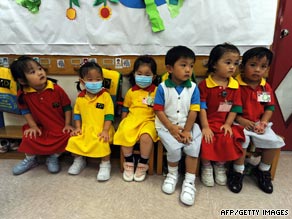
Also Thursday, authorities in Hong Kong ordered the closure of all elementary schools, kindergartens and day care centers in the city after 12 students were found to be infected with the virus.

Authorities have not determined the source of the infection, said Hong Kong's Chief Executive Donald Tsang. This makes it the first cluster of swine flu cases in the city without a link to someone who had traveled overseas.

The number of cases continues to grow in Britain, Japan and Australia -- all of them outside the Americas, where the virus was first detected in April.

Thursday's declaration of a pandemic by the WHO made this the first flu pandemic in 41 years.

In Hong Kong, the schools and day care centers were told to close for 14 days as investigators tried to identify the source of the infection, said Tsang, the chief executive.

The health department will decide after two weeks whether or not to continue the shutdown.

A month ago, Hong Kong quarantined about 300 hotel guests for a week after the first case of the virus was confirmed there.

Hong Kong's abundance of caution stems from the government's unwillingness to see a repeat of the SARS epidemic in 2004, which killed nearly 300 people.

Also on Thursday, Israel's health ministry announced that the number of people diagnosed with swine flu there was 68.

Health officials have begun using the virus' clinical name -- H1N1 -- to reflect that it's actually a combination of several different types of flu and to reduce confusion about whether eating pork can spread the virus. It cannot.

Thursday, June 4, 2009

Officials Confirm Calif's 3rd Swine Flu Death

CONCORD, Calif. (AP) - Health officials have confirmed California's third swine flu death -- and the first death of a child related to the virus in this state.

State officials say a young Contra Costa County girl had been diagnosed with swine flu before she died last Friday.

The county coroner's office identified her as nine-year-old Karen Perez of Concord.

The girl also had another bacterial infection. State and county health officials are studying what role it may have played in her death.

A San Bernardino County man and a Los Angeles County woman also diagnosed with the virus died in May.

According to the Centers for Disease Control and Prevention, 20 swine flu-related deaths have been reported nationwide.

State officials say California has seen about 576 cases of the virus.

Tuesday, May 19, 2009

Confirmed H1N1 Flu Cases Nearing 10,000

Wooooo-EE!

(CNN) -- The number of confirmed H1N1 flu cases worldwide is nearing 10,000, the World Health Organization said Tuesday morning.

Commonly known as swine flu, the outbreak has sickened 9,830 people and caused at least 79 deaths -- mostly in Mexico, the organization said. The actual number of people affected may be higher, as it takes time for national governments to confirm cases and report them to the global body.

In the United States, at least 5,123 cases of swine flu have been reported, according to the latest figures from the Centers for Disease Control and Prevention. The CDC has linked five deaths to the outbreak; health officials in New York have connected a sixth death to the disease.

Concern about the disease deepened Tuesday, even as authorities have said that the outbreak may prove to be less severe than first suspected.

In New York, medical investigators were looking into the death of a baby boy whose mother brought him to Elmhurst Hospital. The baby died Monday evening, said Dario Centorcelli, a hospital spokesman. The cause of death was not immediately known.

That death comes a day after an assistant principal from New York died after contracting the H1N1 virus. That man -- Mitchell Wiener -- had an underlying health condition, said Dr. Thomas Frieden, New York City's health commissioner and President Barack Obama's pick to lead the CDC.

Wiener died Sunday evening of complications of the H1N1 virus, hospital and state officials said.

If confirmed by the Centers for Disease Control and Prevention, Wiener's death would be the sixth linked to swine flu in the United States. The CDC has confirmed three in Texas, one in Arizona and one in Washington state.

Wiener's school is among a handful in New York City that temporarily closed at the recommendation of the city's Health Department.

Frieden said Sunday that "with the virus spreading widely," closing affected schools "will make little difference in transmission throughout New York City, but we hope will help slow transmission within the individual school communities."

The flu strain, which originated in Mexico, killed dozens of people there, causing U.S. officials to worry that it could take a similar toll after spreading across the border.

So far, however, it has acted similar to typical seasonal influenza -- which usually can be treated successfully but can be deadly among the very old, very young and people with pre-existing health problems.

Sunday, May 17, 2009

Utttt-Ohhhh....

NEW YORK (CNN) -- An New York middle school assistant principal who was hospitalized with the H1N1 virus, commonly known as swine flu, died Sunday apparently from flu complications, a hospital spokesman said.

Mitchell Weiner, 55, assistant principal at Intermediate School 238 in Queens, died at 6:17 p.m. Sunday, Flushing Hospital spokesman Andrew Rubin said.

"We believe he had complications of the swine flu," Rubin told CNN Radio, adding that once Weiner was admitted to the hospital, he was listed in critical condition. However, he wouldn't say whether Rubin had any pre-existing medical conditions.

"It is with great sadness tonight that we learn that New York has lost one of its residents to an illness related to H1N1," New York Gov. David Paterson said.

Last week, when city and state officials announced that four students were infected and a school official in Queens was "critically ill" with the virus, Mayor Michael Bloomberg did not name the official. He described the staffer as an assistant principal who "may have had other health problems."

"We're trying to identify that and ascertain whether those problems were exacerbated by the flu or whether it's totally unrelated," Bloomberg said at the time.

Since the H1N1 outbreak surfaced last month, the Centers for Disease Control and Prevention and Prevention has linked four U.S. deaths to the virus: A Washington state man with heart problems who died from flu complications; an Arizona woman with lung disease; a Mexican toddler who was visiting with her family and a pregnant woman who had been on life support since April. All had preexisting medical problems.

Weiner's school is one of eight schools temporarily closed in New York due to flu concerns.

"We are now seeing a rising tide of flu in many parts of New York City," said New York City Health Commissioner Thomas R. Frieden earlier Sunday.


"With the virus spreading widely, closing these and other individual schools will make little difference in transmission throughout New York City, but we hope will help slow transmission within the individual school communities."

The flu strain, which originated in Mexico, killed dozens of people there, causing U.S. officials to worry that it could take a similar toll after spreading across the border. But it has thus far acted similar to typical seasonal influenza -- which usually can be treated successfully but can be deadly among the very old, very young and people with preexisting health problems.

Friday, May 8, 2009

Are You Kidding Me?

How can you compare chicken pox to a potentially life threatening illness? Are these parents for real?

(CNN): You can probably picture the scene. Well, sort of…

Parents gather in a suburban living room, eating cookies, having coffee and discussing how quickly their children outgrow their new clothes.

Meanwhile, in the play room, the kids lay on mats and cushions, tired from an intense hide-and-seek and tag session. But then, the parents encourage the children to share ice cream spoons, whistles, soda cups even bubble gum.

Does that sound strange? Maybe. But this is exactly what happened at chicken pox parties that some of us grew up with. And the point is to have the boy with the red dots on his face infect all of the small children in the room.

Usually parents who want their healthy children to get chickenpox believe it will help them build immunity against more virulent strains. Others oppose vaccination.


Now there’s a growing buzz on the Internet about “swine flu parties,” and it has medical experts across the country up in arms as the H1N1 virus continues to spread across the U.S. In fact the US Centers for Disease Control and Prevention, (CDC), says it “expects that more cases, more hospitalizations and more deaths from this outbreak will occur over the coming days and weeks”.

The “swine flu party” chatter on flu web sites and public health blogs like Effectmeasure has even gotten the attention of a top US health official.

Having a “swine flu party” is “a big mistake,” said Richard Besser, the acting head of the CDC. “This is a new, emerging infection, and we’re learning more about it each day,” he said. “How an individual person will be impacted by the infection is not something that we know.”

“It’s a big mistake putting individuals and children at risk, and the CDC does not recommend that people follow that course,” he said.

US health officials fear that the unpredictable and potentially deadly A(H1N1) flu virus could mutate and appear as a more virulent, drug-resistant strain later in the year.

In fact as winter and the flu season approach in South America, the continent is on high alert for swine flu or A(H1N1).

In Colombia, the South American country closest to Mexico, authorities scrambled to stockpile antiviral medication and told schools to send home children who show up sick. So far, one case has been confirmed in the country of over 45 million, and dozens are under observation. Colombia has become the first South American country to confirm a case of swine flu but not the only one, just hours ago four were confirmed in Brazil and one in Argentina.

Meanwhile signs that things may be improving in Mexico, this weekend, Mexican soccer federation will allow fans to attend professional soccer games again.

Sunday, May 3, 2009

Flu Hysteria Is Real Danger, Some Say

(CNN) -- As the number of swine flu cases rises around the world, so is a gradual backlash -- with some saying the threat the virus poses is overblown.

By Sunday, 787 cases of the virus, known as influenza A (H1N1), had been confirmed in 17 countries, the World Health Organization said. The number of fatalities grew to 20.

"There is too much hysteria in the country and so far, there hasn't been that great a danger," said Congressman Ron Paul, a Republican from Texas. "It's overblown, grossly so."

Paul, who was a freshman senator during a swine flu outbreak in 1976, said Congress voted to inoculate the whole country at the time.

Twenty-five people died from the inoculation while one person was killed by the flu, Paul said, adding that he voted against inoculation.
The United States' only death this year from the virus was a 22-month-old boy in Texas who was visiting from Mexico. The other 19 cases were in Mexico.

"I wish people would back off a little bit," Paul said.

Others shared Paul's sentiment, saying the fear of the flu has gotten out of hand.

"We have people without symptoms going into the emergency rooms asking to be screened for swine flu at the expense of people with real illness," said Cathy Gichema, a nurse in Pikesville, Maryland.

"Schools are being shut for probable causes - sending these kids congregating to the malls. How is that helping," Gichema said.

Dr. Mark Bell, principal of Emergent Medical Associates, which operates 18 emergency departments in Southern California, said the level of fear is unprecedented.

"I haven't seen such a panic among communities perhaps ever," Bell said. "Right now, people think if they have a cough or a cold, they're going to die. That's a scary, frightening place to be in. I wish that this hysteria had not occurred and that we had tempered a little bit of our opinions and thoughts and fears in the media."

Governments and health officials, however, say the concern is not unfounded.

The virus -- a hybrid of swine, avian and human flu -- can jump from person to person with relative ease. And while most of the cases were reported in Mexico and the United States, it has also been confirmed in countries outside North America.

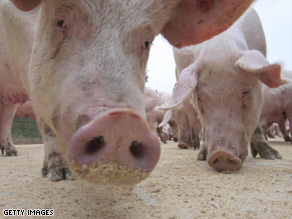
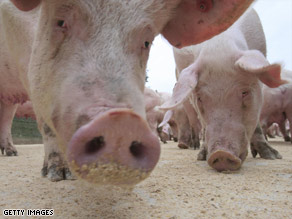
On Saturday, the virus strain was found in a herd of swine in Alberta, Canada, and the animals may have caught the flu from a farmer who recently returned from a trip to Mexico.

It could be the first identified case of pigs infected in the recent outbreak.

"We have determined that the virus H1N1, found in these pigs, is the virus which is being tracked in the human population," said Brian Evans of the Canadian Food Inspection Agency.

But Evans and other officials said it is not uncommon for flu viruses to jump from humans to animals, and that it does not pose a risk for consuming pork. The number of pigs infected was not disclosed.

In his weekly radio address Saturday, President Obama said the concerns over the new virus are justified because lack of immunity makes it potentially risky.

"Unlike the various strains of animal flu that was in the past, it's a flu that is spreading from human to human. This creates the potential for a pandemic which is why we are acting quickly and aggressively," Obama said.

The president, who said the virus is a "cause for concern but not alarm," added that the government has anti-viral treatment to treat the current strain of H1N1.

In addition, the WHO started distributing 2.4 million doses of a common anti-viral drug to 72 nations.
"I think the world is infinitely better prepared than it was 90 years ago," said WHO spokesman Gregory Hartl, referring to the 1918 Spanish flu pandemic that killed as many as 20 million people.

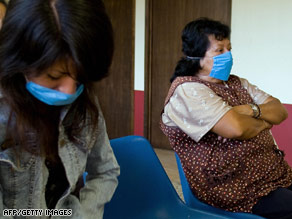
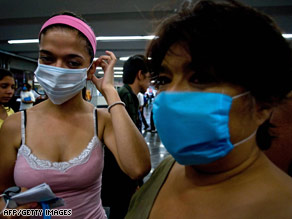
In Mexico -- the epicenter of the outbreak -- masks have become a common fixture. Nearly half those cases in the country involve patients 19 and younger, the health ministry said.

"I can hold for maybe another week or two and that's it," said Guillermo Jimenez, a waiter who hasn't worked in a week since the government ordered about 35,000 public venues to shut down. "We don't have any money. We have mouths to feed. I don't know what I'm going to do now."

Still, some say the hype over H1N1 has led to undue hysteria.

"I'm sure the deaths in Mexico have something do with the infrastructure," said Anthony Markovich, a graduate student in Marina del Ray, California. "I know our health care system has its flaws, but it is more advanced."

The world should focus on diseases that have more fatalities, according to Markovich.

"This is a joke compared to other things going on," he said. "Malaria is killing thousands of people daily, the economy is not getting any better, it is time to move on."

Pakistan resident Faisal Kapadia agreed.

"When you put it in context, 700 cases in the world is nothing," said Kapadia, a commodities trader in Karachi. "I understand it is a horrible new disease and governments should find a cure for it, but the media has created too much paranoia."

Wednesday, April 29, 2009

U.S. Swine Flu Cases Grow To 91 - One Infant Death

WASHINGTON (CNN) -- The number of confirmed swine flu cases in the United States has risen to 91 and is spread across 10 states, the Centers for Disease Control and Prevention said Wednesday.

One of those cases was fatal, but the majority are not severe, said Dr. Richard Besser, acting CDC chief. Five patients have been hospitalized, including the 22-month-old child who died Monday in Texas, he said.

The toddler was a Mexican citizen who had gone to Houston, Texas, for treatment, said Kathy Barton, a spokeswoman for the Houston Department of Health and Human Services.

At a news conference unrelated to the health issue, President Obama said, "My thoughts and prayers and deepest condolences go out to the family as well as [to] those who are ill and recovering from this flu."

Obama said, "This is obviously a serious situation -- serious enough to take the utmost precautions."

Homeland Security Secretary Janet Napolitano and newly confirmed Health and Human Services Secretary Kathleen Sebelius are closely monitoring the swine flu outbreak, Obama said.

The president urged local health officials to be vigilant about identifying and reporting suspected cases.

Places such as schools should consider closing temporarily if any illness surfaces there, he said, and parents should consider in advance how children at home will be cared for. Sending a child to a day-care facility may not be the best solution, he said.

Obama said he requested $1.5 billion in emergency funding from Congress on Tuesday if the outbreak becomes more widespread.

The government is releasing nearly 13 million doses of antiviral medications to stem the spread of swine flu, Napolitano said Wednesday.

"The national stockpile has 50 million courses, and we are releasing 25 percent of the state portion already," Napolitano told the Senate Committee on Homeland Security and Governmental Affairs, which convened to discuss the federal response to the swine flu outbreak.

A U.S. Marine stationed in Southern California has been tested to see if he has swine flu, the Pentagon said Wednesday. The Marine and his roommate, who isn't ill, have been quarantined at the Marine base in Twentynine Palms while awaiting test results, expected within 48 hours, said Gen. James T. Conway, the Marine Corps commandant.

An official at the World Health Organization said Wednesday that his agency has confirmed 114 cases of swine flu worldwide.

However, that number does not include the additional U.S. cases. The WHO was still listing 64 swine flu cases for the United States.

"It's clear that the virus is spreading, and we don't see it slowing down at this point," said Dr. Keiji Fukuda, assistant director-general of WHO, at a news conference. He said the most severe cases are in Mexico; other countries have milder cases so far. iReport.com: "Regular life" in Mexico with masks

Earlier Wednesday, the CDC's Besser confirmed the child's death.

"A child has died from the H1N1 virus," he said. "As a parent and a pediatrician, my heart goes out to the family."

He added, "We have expected that over time we would see deaths from this infection, and that's what we're finding."

Sixteen of the confirmed swine flu cases in the United States have been reported in Texas, and 51 in New York, according to the CDC. California has 14 confirmed cases, the agency said.

The CDC is "taking aggressive action to try and limit the impact of this on our communities" but isn't changing its recommendations as a result of the confirmed swine flu death, Besser said.

"I expect we'll see more cases," he said. "And as we do, we'll learn more about this, and if there needs to be more stringent or less stringent recommendations, we'll be making those."

Of the confirmed cases worldwide, there have been seven other confirmed swine flu deaths, all in Mexico.

"Given what we've seen in Mexico, we have expected that we would see more severe infections and would see deaths," Besser said.

However, he stressed that people should maintain their perspective on the swine flu outbreak.

"Seasonal flu each year causes tens of thousands of deaths in this country -- on average, about 36,000 deaths," Besser said. "And so this flu virus in the United States, as we're looking at it, is not acting very differently from what we saw during the flu season."

Sunday, April 26, 2009

And MORE Flu: U.S. Declares Public Health Emergency As Swine Flu Spreads

(CNN) -- The United States government declared a public health emergency Sunday as the number of identified cases of swine flu in the nation rose to 20.

The declaration is part of a "standard operating procedure" that will make available additional government resources to combat the virus, Homeland Security Secretary Janet Napolitano said at the White House.

Additional cases of swine flu are expected to be reported in the coming days, added Dr. Richard Besser, acting director of the Centers for Disease Control and Prevention.

No one has died in the U.S. from swine flu, officials said Sunday.

In New York City, Mayor Michael Bloomberg said eight students at St. Francis Prepatory School in Queens have tested positive for swine flu. More than 100 students at the school were absent with flu-like symptoms last week, he said.

State public health officials in Ohio confirmed one case of swine flu on Sunday. There have been seven confirmed cases in California, two in Kansas, and two in Texas, Besser said.

The World Health Organization advised all countries to be on the lookout for "unusual" outbreaks of flu, after an emergency meeting Saturday as the seriousness of the outbreak became clear.

CDC: 8 New York Students Have Swine Flu

NEW YORK (CNN) -- The Centers for Disease Control and Prevention has confirmed cases of swine flu in eight students at a New York preparatory school, Mayor Michael Bloomberg said Sunday.

The students have had only mild symptoms and none have been hospitalized, he said. Some of the students have already recovered.

More than 100 students were absent from school due to flu-like symptoms last week. New York health officials tested samples for eight students Saturday and determined the students were probably suffering from swine flu, and the CDC confirmed the diagnosis on Sunday, Bloomberg said.

The announcement brings the number of confirmed swine flu cases in the United States to 20. Bloomberg and New York Health Commissioner Tom Frieden said there is no sign of a citywide outbreak of the flu, and no sign of a potential outbreak of swine flu at other schools.

Some students at the school spent spring break in Mexico, Bloomberg said, but authorities have not determined whether any of the students with a confirmed case of swine flu was in Mexico. Someone who traveled to Mexico may not have had any flu symptoms but passed on the flu to someone else, he noted.

Frieden called on students who are home sick to stay home for 48 hours after their symptoms subside.

If symptoms are normal for a regular kind of flu, there is no need to go to a hospital, said Bloomberg. If symptoms become severe, as with any illness, people should go to the hospital, he said.

St. Francis, which has 2,700 students, announced it will remain closed for two days. Asked whether the students' illnesses have been minor because they're young and healthy or because it is a minor strain of the virus, Frieden responded, "We don't know."


It has been a "relatively mild" flu season, Frieden said.

"We don't know whether this strain has been circulating more widely."

81 Dead In Mexico As Flu Emergency Goes Global


(CNN) -- Mexican officials are asking citizens to avoid large crowds, refrain from kissing as a greeting and maintain a distance of at least 1.8 meters (six feet) from each other amid growing concern in the country and elsewhere over new cases of suspected and confirmed swine flu infection.

Several countries issued travel notices and tightened restrictions to brace against the virus the World Health Organization is calling "a public health emergency of international concern."

By Sunday, 81 deaths had been deemed "likely linked" to a deadly new strain of the virus by health authorities in Mexico. Viral testing has confirmed 20 cases, said Dr. Jose A. Cordova Villalobos, Mexico's health secretary. In the United States, the number of confirmed swine flu cases stood at 11.

In New Zealand, officials said 22 students and three teachers, who returned from a three-week-long language trip to Mexico, may have been infected with the virus.

The 25 students and teachers at Auckland's Rangitoto College returned to New Zealand via Los Angeles on Saturday.

Fourteen have shown flu-like symptoms, with four "more unwell than others," said Dr. Julia Peters, clinical director of Auckland Regional Public Health Service.

Health Minister Tony Ryall said 10 students tested positive for influenza A. The specimens will be sent to WHO to determine whether it is H1N1 swine influenza. H1N1 influenza is a subset of influenza A.

The WHO results are expected back by midweek. The group remains quarantined at home.

"It's certainly has not been confirmed that they have swine flu," said Dr. Craig Thornley, medical officer of health in influenza. "We already have provisional information that some of the group have influenza A. We won't know if they have the type of influenza A that is swine flu."

In England, authorities stressed that a crew member who developed flu-like symptoms during a flight from Mexico City to Heathrow did not test positive for swine flu.

"I can confirm that the patient doesn't have swine flu," said Jonathan Street, a spokesman for Northwick Park Hospital in London.

"We have done all test, and they all came back negative."

In Israel, doctors are running tests on a man who recently returned from Mexico with light flu symptoms.

U.S. health officials said Friday that some cases of the virus in the United States matched samples of the deadly Mexican virus. All the patients have recovered or are expected to.

The panic over the virus prompted Canada to issue a travel health notice, saying the public health agency was "tracking clusters of severe respiratory illness with deaths in Mexico."

South Korea said it will test airline passengers arriving from the United States. And Japan will convene a Cabinet meeting Monday to come up with measures to block the entry of the virus into the country.

The United States had not issued any travel warnings or quarantines.

But US Airways said Saturday night it would allow passengers to change plans if they wanted to because of the outbreak.

Airline spokeswoman Michelle Mohr said it was not asking people not to travel to Mexico, but wanted to "give them that flexibility" if "they don't feel comfortable."

Gregory Hartl, of the World Health Organization, said the strain of the virus seen in Mexico is worrisome because it has mutated from older strains.

"Any time that there is a virus which changes ... it means perhaps the immunities the human body has built up to dealing with influenza might not be adjusted well enough to dealing with this new virus," Hartl said.

He said that, in Mexico, otherwise young, healthy people have been hit by the virus -- "one of the pieces of the puzzle that is worrying us," he said.

Mexico City has closed all of its schools and universities until further notice because of the virus.

More than 1,300 people with flu-like symptoms have been admitted to hospitals in Mexico, and officials are trying to determine how many of them have swine flu, said Jose Cordova Villalobos, the country's health minister.

The H1N1 strain of swine flu is usually associated with pigs. When the flu spreads person-to-person, instead of from animals to humans, it can continue to mutate, making it a tougher strain that is harder to treat or fight off.

Symptoms of swine flu include fever, lethargy, lack of appetite, coughing, runny nose, sore throat, nausea, vomiting and diarrhea, the CDC said.

President Barack Obama, who visited Mexico last week en route to the Summit of the Americas in Trinidad and Tobago, is not sick.

"The president's trip to Mexico has not put his health in any danger," spokesman Robert Gibbs said.

Saturday, April 25, 2009

Oh, Shit!

(CNN) -- The presence of swine flu in Mexico and the United States is "a serious situation" that could develop into a pandemic, the World Health Organization's director-general said Saturday.

"This is an animal strain of the H1N1 virus and it has pandemic potential because it is infecting people," Dr. Margaret Chan said Saturday speaking to reporters by phone.

In Mexico, 68 people have died from swine flu, according to a statement from the U.S. Embassy in Mexico.

Eight people were confirmed to have swine flu in the United States; six in California and two in Texas, according to the U.S. Centers for Disease Control and Prevention.

All eight have recovered, according to CDC's acting Director Richard Besser.

Preliminary results from tests of students at a New York school do not rule out swine flu, the director of surveillance for the Bureau of Communicable Diseases said Saturday.

Dr. Don Weiss said the samples will now be sent to the Centers for Disease Control and Prevention. Test results could be known by Sunday.

He said the samples came back positive for "Type A" flu and the tests will need to determine the samples' subtype.

He said up to 100 students at the Queens school reported feeling ill.

CDC has tested 14 samples of the virus from Mexico and found seven were identical to the virus found in the U.S. cases, Besser said.

"This situation has been developing quickly," he said. "This is something we are worried about."

Asked whether the committee would address raising the agency's alert concerning the virus to 6, a pandemic alert and the highest level on WHO's scale, Chan said, "Yes, indeed."

The alert stands at 3, meaning "No or very limited human-to-human transmission."

Chan said Saturday that WHO does not have indications of similar outbreaks elsewhere.

However, she said, "The situation is evolving quickly. A new disease is by definition poorly understood."

White House spokesman Reid Cherlin said Saturday that the White House was taking the situation "seriously and monitoring for any developments."

Health officials in Texas announced Saturday the temporary closure of Byron Steel High School in Cibolo, Texas, where swine flu was confirmed in two students earlier this month.

"The purpose is to reduce the risk to students, staff and the community," said Dr. Sandra Guerra, a public health official in Guadalupe County, Texas.

Mexico City has closed all of its schools and universities until further notice because of the virus, and on Saturday, the country's National Health Council said all soccer games would be played Saturday without public audiences.

More than 1,000 people have been sickened in the country, and officials are trying to determine how many of those patients had swine flu, the country's health minister, Jose Angel Cordova Villalobos, said.

None of the U.S. patients had direct contact with pigs, though a patient who lives in San Diego had traveled to Mexico, the CDC said.

Besser said officials had not found common exposure or behavior among the eight U.S. patients.

"We have not seen any linkage at all between the cases in Texas and California," he said.

The new virus has genes from North American swine influenza, avian influenza, human influenza and a form of swine influenza normally found in Asia and Europe, said Nancy Cox, chief of the CDC's Influenza Division.

Swine flu is caused by a virus similar to a type of flu virus that infects people every year but is a strain typically found only in pigs -- or in people who have direct contact with pigs.

There have, however, been cases of person-to-person transmission of swine flu, the CDC said. Officials found evidence, for example, that a patient transmitted the disease to health care workers during a 1988 apparent swine flu infection among pigs in Wisconsin.

Experts think coughing, sneezing and contaminated surfaces spread the infection among people.

The new strain of swine flu has resisted some antiviral drugs, officials said.

The human influenza vaccine's ability to protect against the new swine flu strain is unknown, and studies are ongoing, said Dr. Anne Schuchat, the CDC's interim deputy director for science and public health program. There is no danger of contracting the virus from eating pork products, she said.

Canada is also testing samples from Mexico "and has placed a travel alert for travel to Mexico," CDC spokesman David Daigle told CNN by e-mail.

The United States had not issued any travel alerts or advisories by late Friday, but some private companies issued their own warnings.