
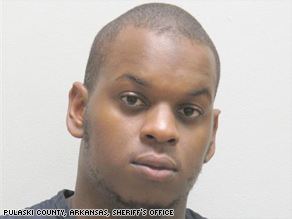
 LITTLE ROCK (CNN) -- The Tennessee man suspected in Monday's attack on a recruitment center in Little Rock, Arkansas, was brainwashed and tortured while imprisoned in Yemen, his lawyer said Thursday.
"My client is a young man, I think, brainwashed," attorney Jim Hensley told CNN. "What else could be explained for a young man who's a true American, plays football, helps his grandmother and mows the lawns of his neighbors? Comes back and then finds himself in this situation? That is not a normal situation in my book."
Abdulhakim Muhammad, formerly known as Carlos Bledsoe, is charged with killing Pvt. William Long, 23, of Conway, Arkansas, and wounding Pvt. Quinton Ezeagwula, 18, of Jacksonville, Arkansas.
The 23-year-old convert to Islam has pleaded not guilty. But, according to court records, he told police that he had "political and religious" motives for the shooting.
In September 2007, Muhammad left Tennessee State University in Nashville, where he was studying business, and traveled to Yemen to teach English to children and to learn Arabic.
There, "he felt at peace with these people," even marrying a Yemeni, Hensley said.
But things began to change when his client was detained for a minor visa violation in Yemen and sent to prison, where he was housed with radical Islamic fundamentalists, Hensley said.
In November 2008, Muhammad was arrested in the port city of Aden for overstaying his visa and deported two months later in cooperation with the U.S. Embassy, a Yemeni official said.
There is disagreement about the time he was incarcerated. The lawyer said Muhammad told him he had served four months in prison.
Hensley said Muhammad told him that, during the last two weeks he was held, he was deprived of sleep and food and "was slapped around a little bit," enduring beatings on the backs of his legs.
During Muhammad's time in the prison, an FBI agent visited him not as an ally but as an interrogator, Hensley said.
However, Mohammed AlBasha, a spokesman for the Yemeni Embassy, rejected Hensley's assertion. "It is understood that the process of radicalization can take a number of years, not a couple of weeks," he said. "So, the statement that his lawyer made, that he was brainwashed and tortured for weeks in Yemen, are baseless."
The FBI agent "believed that Carlos was some kind of hardened terrorist hellbent on doing violence to America," Hensley said.
After he was released in January, Muhammad returned to Nashville, Tennessee, where his parents noticed their son was "fidgety, frustrated, can't sit still," Hensley said.
The same FBI agent approached him and threatened to put him under surveillance, "to do everything we can to cause you trouble," Hensley said.
A federal law enforcement source told CNN that the FBI was investigating Muhammad, but FBI spokesmen would not confirm any contact they might have had.
Hensley added that Muhammad's parents told him that, once he returned to Nashville, "he was a different human," one who blamed the United States for the war wounds suffered by some of the children whom he had taught, children without arms or legs.
He also blamed U.S. immigration policy for his inability to bring his bride back to the United States with him, Hensley said.
"A first-year psychology student would be able to see that this young man needed some help, and that wasn't offered him by anyone," Hensley said.
Muhammad eventually moved to Little Rock to help his father's Memphis tour business expand into Arkansas.
Just before the shooting, he was working out of a Hilton hotel in Little Rock in the family business, driving a sightseeing van.
Hensley said he was speaking to the news media because Muhammad had asked him to. "His agenda is different from mine; he wants to be a martyr," the lawyer said.
The case has attracted high-level attention, with President Obama saying Thursday in a written statement that he was "deeply saddened" by the shootings.
Federal agents said Wednesday that they were looking into whether Internet searches of various locations in several other U.S. cities were a sign that Muhammad was seeking "additional targets." The cities investigators included Atlanta, Georgia; Louisville, Kentucky; New York; Philadelphia, Pennsylvania; and Memphis, Tennessee, where Muhammad grew up.
Hensley told CNN that his client was not the only person who was using the computer.
Muhammad is being held on a state count of capital murder and 16 counts of engaging in a terrorist act by firing into an occupied building.


