Showing posts with label west virginia. Show all posts

Saturday, June 30, 2012

Eastern US Storms Kill 13, Cut Power to Millions


WASHINGTON (AP) — Millions across the mid-Atlantic region sweltered Saturday in the aftermath of violent storms that pummeled the eastern U.S. with high winds and downed trees, killing at least 13 people and leaving 3 million without power during a heat wave.

Power officials said the outages wouldn't be repaired for several days to a week, likening the damage to a serious hurricane. Emergencies were declared in Maryland, West Virginia, Ohio, the District of Columbia and Virginia, where Gov. Bob McDonnell said the state had its largest non-hurricane outage in history, as more storms threatened. "This is a very dangerous situation," the governor said.

In West Virginia, 232 Amtrak passengers spent Friday night on a train that was blocked on both sides by trees that fell on the tracks, and they were waiting for buses to pick them up Saturday. And in Illinois, storm damage forced the transfer of dozens of maximum-security, mentally ill prisoners from one prison to another.

In some Virginia suburbs of Washington, emergency 911 call centers were out of service; residents were told to call local police and fire departments. Huge trees fell across streets in Washington, leaving cars crunched up next to them, and onto the fairway at the AT&T National golf tournament in Maryland. Cell phone and Internet service was spotty, gas stations shut down and residents were urged to conserve water until sewage plants returned to power.

The outages were especially dangerous because they left the region without air conditioning in an oppressive heat. Temperatures soared to highs in the mid-90s in Baltimore and Washington, where it had hit 104 on Friday.

"I've called everybody except for the state police to try to get power going," said Karen Fryer, resident services director at two assisted living facilities in Washington. The facilities had generator power, but needed to go out for portable air conditioning units, and Fryer worried about a few of her 100 residents who needed backup power for portable oxygen.

On Saturday night, the train passengers stranded near rural Prince, W.Va., were waiting for buses to pick them up after they got stuck at 11 p.m. the previous evening, said Amtrak spokesman Steve Kulm. Kulm said the train bound from New York to Chicago has power, so lights and air conditioning are working. He says that since it's a long-distance train, it was stocked with food and crew members were able to get to town to buy more.

Kulm says passengers should be on the buses sometime Saturday evening.

About 170 miles to the northeast in Morgantown, W.Va., Jeff and Alice Haney loaded their cart at Lowe's with cases of water, extra flashlights and batteries, and wiring for the generator they hoped would be enough to kick-start their air conditioner. Even if they had to live without cool air, the family had a backup plan.

"We have a pool," Jeff Haney said, "so we'll be OK."

The storm did damage from Indiana to New Jersey, although the bulk of it was in West Virginia, Washington and suburban Virginia and Maryland. At least six of the dead were killed in Virginia, including a 90-year-old woman asleep in bed when a tree slammed into her home. Two young cousins in New Jersey were killed when a tree fell on their tent while camping. Two were killed in Maryland, one in Ohio, one in Kentucky and one in Washington.

Illinois corrections officials transferred 78 inmates from a prison in Dixon to the Pontiac Correctional Center after storms Friday night caused significant damage, Department of Corrections spokeswoman Stacey Solano said.

No one was injured, Solano said. Generators are providing power to the prison, which is locked down, confining remaining inmates to their cells.

Utility officials said it could take at least several days to restore power to all customers because of the sheer magnitude of the outages and the destruction. Winds and toppled trees brought down entire power lines, and debris has to be cleared from power stations and other structures. All of that takes time and can't be accomplished with the flip of a switch.

"This is very unfortunate timing," said Myra Oppel, a spokeswoman for Pepco, which reported over 400,000 outages in Washington and its suburbs. "We do understand the hardship that this brings, especially with the heat as intense at is. We will be working around the clock until we get the last customer on."

Especially at risk were children, the sick and the elderly. In Charleston, W.Va., firefighters helped several people using walkers and wheelchairs get to emergency shelters. One of them, David Gunnoe, uses a wheelchair and had to spend the night in the community room of his apartment complex because the power — and his elevator — went out. Rescuers went up five floors to retrieve his medication.

Gunnoe said he was grateful for the air conditioning, but hoped power would be restored so he could go home.

"It doesn't matter if it's under a rock some place. When you get used to a place, it's home," he said.

More than 20 elderly residents at an apartment home in Indianapolis were displaced when the facility lost power due to a downed tree. Most were bused to a Red Cross facility to spend the night, and others who depend on oxygen assistance were given other accommodations, the fire department said.

Others sought refuge in shopping malls, movie theaters and other places where the air conditioning would be turned to "high."

In Richmond, Va., Tracey Phalen relaxed with her teenage son under the shade of a coffee-house umbrella rather than suffer through the stifling heat of her house, which lost power.

"We'll probably go to a movie theater at the top of the day," she said.

Phalen said Hurricane Irene left her home dark for six days last summer, "and this is reminiscent of that," she said.

Others scheduled impromptu "staycations" or took shelter with friends and relatives.

Robert Clements, 28, said he showered by flashlight on Friday night after power went out at his home in Fairfax, Va. The apartment complex where he lives told his fiancee that power wouldn't be back on for at least two days, and she booked a hotel on Saturday.

Clements' fiancee, 27-year-old Ann Marie Tropiano, said she tried to go to the pool, but it was closed because there was no electricity so the pumps weren't working. She figured the electricity would eventually come back on, but she awoke to find her thermostat reading 81 degrees and slowly climbing. Closing the blinds and curtains didn't help.

"It feels like an oven," she said.

At the AT&T National in Bethesda, Md., trees cracked at their trunks crashed onto the 14th hole and onto ropes that had lined the fairways. The third round of play was suspended for several hours Saturday and was closed to volunteers and spectators. Mark Russell, the PGA Tour's vice president of rules and competition, couldn't remember another time that a tour event was closed to fans.

"It's too dangerous out here," Russell said. "There's a lot of huge limbs. There's a lot of debris. It's like a tornado came through here. It's just not safe."

The outages disrupted service for many subscribers to Netflix, Instagram and Pinterest when the storm cut power to some of Amazon Inc.'s operations. The video and photo sharing services took to Twitter and Facebook to update subscribers on the outages. Netflix and Pinterest had restored service by Saturday afternoon.

The storm that whipped through the region Friday night was called a derecho (duh-RAY'-choh) , a straight line wind storm that sweeps over a large area at high speed. It can produce tornado-like damage. The storm, which can pack wind gusts of up to 90 mph, began in the Midwest, passed over the Appalachian Mountains and then drew new strength from a high pressure system as it hit the southeastern U.S., said Bryan Jackson, a meteorologist with the National Weather Service.

"It's one of those storms," Jackson said. "It just plows through."


Saturday, June 2, 2012

Death of Snake Handling Preacher Shines Light on Lethal Appalachian Tradition

(CNN) – Mack Wolford, one of the most famous Pentecostal serpent handlers in Appalachia, was laid to rest Saturday at a low-key service at his West Virginia church a week after succumbing to a snake bite that made headlines across the nation.
Several dozen family, friends and members of Wolford's House of the Lord Jesus church in tiny Matoaka filled the simple hall for the service, which lasted slightly more than an hour. At the request of pastor's widow, Fran Wolford, media were forbidden inside the building.

Wolford's own dad was a serpent handler who died from a snake bite in 1983.
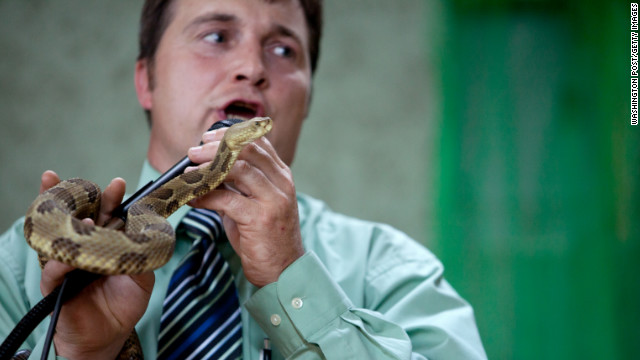
Mack Wolford, who was 44, was bitten by his yellow timber rattlesnake at an evangelistic event in a state park about 80 miles west of Bluefield, in West Virginia’s isolated southern tip.

He enjoyed handling snakes during worship services, but it’s a tradition that has killed about 100 practitioners since it started in the east Tennessee hills in 1909.
In recent years, Wolford feared the tradition was in danger of dying for lack of interest among people in their 20s and 30s. It’s why he drove to small, out-of-the-way churches around Appalachia to encourage those who handle snakes to keep the tradition alive.
“I promised the Lord I’d do everything in my power to keep the faith going,” Wolford said last fall in an interview I conducted with him for the Washington Post Sunday magazine. “I spend a lot of time going a lot of places that handle serpents to keep them motivated. I’m trying to get anybody I can get.
He hadn’t much hope for churches in West Virginia, where serpent handling is legal. Some surrounding states, including Tennessee and North Carolina, have outlawed it. He had his eyes on a Baptist church near Marion, North Carolina, where, he said, “there’s been crowds coming” and its leaders wanted to introduce serpent handling, the law be damned.
“I’m getting the faith started in other states, where I am seeing a positive turnout,” he said. “Remember, back in the Bible, it was the miracles that drew people to Christ.”

Wolford wanted to travel to the radical edges of Christianity, where life and death gazed at him every time he walked into a church and picked up a snake. That’s what drew the crowds and the media; that’s what gives a preacher from the middle of nowhere the platform to offer the gospel to people who would never otherwise listen.
“Mack was one of the hopes for a revival of the tradition,” said Ralph Hood, a University of Tennessee professor who’s written two books on snake handlers and is probably the foremost academic expert on their culture. “However, I am sure others will emerge, as well.”

Indeed, others are emerging, including a growing group of 20-somethings clustered around churches in La Follette, Tennessee, and Middlesboro, Kentucky. Their individual Facebook pages show photos of poisonous snakes and “serpent handling” appears on their “activities and interests” lists.

Pentecostal serpent handlers - they use "serpent" over "snake" out of deference to the Bible - are known for collecting dozens of snakes expressly for church services.

At church, they’re also known to ingest a mixture of strychnine - a highly toxic powder often used as a pesticide - and water, often from a Mason jar. These same believers will bring Coke bottles with oil-soaked wicks to the church so they can hold flames to their skin.

Key to understanding this culture are a pair of verses from the Gospel of Mark in the New Testament: “And these signs will follow those who believe: in My name they will cast out demons; they will speak with new tongues; they will take up serpents; and if they drink anything deadly, it will by no means hurt them; they will lay their hands on the sick, and they will recover.”

Mainstream Christians - Pentecostals included - do not believe Mark 16:17-18 means that Christians should seek out poisonous snakes or ingest poisonous substances.

But experts say that several thousand people – exact numbers are hard to come by – in six Appalachian states read the verse differently. Known as “signs following” Pentecostals, they see a world at war with evil powers and believe it’s a Christian’s duty to take on the devil by engaging in the “signs.”

Thus, a typical service in one of their churches will also include prayers for healing and speaking in tongues.

But it’s the seeming ability to handle poisonous snakes without dying from their bites that makes these Pentecostals believe that God gives supernatural abilities to those willing to lay their lives on the line. If they are bitten, they refuse to seek antivenin medication, believing it’s up to God to heal them.

At the Church of the Lord Jesus in Jolo, West Virginia - one of the country’s most famous “signs following” churches - a group of worship leaders passed around a rattlesnake at a service last year on Labor Day weekend. The snake twisted as it was passed from man to man.

The women clapped, and one tried handling the serpent but quickly gave it back to a man. The pastor, Harvey Payne - who has never been bitten by a serpent - posed for the cameras, the reptile twisting and curling.

“My life is on the line,” he exulted. “All Holy Ghost power!”

If a believer is bitten by a snake and dies, these Pentecostals reason, it is simply their time to go.

“It devastated me,” one Tennessee serpent handler confided to me about Wolford’s death last week. “It just shook my very foundation. But (handling snakes) is still the Word of God.”

Vicie Haywood, Wolford’s mother - whose husband died 29 years ago from a rattlesnake bite during a worship service - is heartbroken. But she has no doubts about the righteousness of serpent handling. “It’s still the Word, and I want to go on doing what the Word says,” she told the Washington Post on Wednesday.

Last fall I asked Wolford if handling serpents wasn’t tempting God, a common question from mainstream Christians.

“Tempting God is disbelief in God, not belief in Him,” he said, citing an incident in the Old Testament in which Moses slapped his staff against a rock to provide water in the desert rather than speak to the rock as God had commanded.

By using his own resources – a stick – rather than counting on God to act when Moses simply spoke to the rock, the patriarch was condemned for lack of belief and forbidden to enter the Promised Land.
He added that he regularly drinks strychnine during worship services, to show God has power over poison.
“In my life I’ve probably drunk two gallons of it,” Wolford said. “Once you drink it, there is no turning back. All your muscles contract at once. Your body starts stiffening out. Your lungs; it’s like you can’t breathe.”
He’d gotten sick from strychnine a handful of times. “I was up all night struggling to breathe and move my muscles and repeating Bible verses that say you can ‘drink any deadly thing and it won’t hurt you,’ ” Wolford told me, recounting one episode. He said a voice in his head taunted him as he struggled to recover.
“The devil said, ‘You’re going to die, you’re going to die,’ ” he said. “You can’t go to the hospital. There is not a lot they can do. But (seeking medical help) means you’re already starting to lose faith.”
After he was bitten last Sunday, Wolford may have thought his faith would bring him through that trauma, as it had so many times before. He had four spots on his right hand from where copperheads had bitten him.

When he finally gave his family permission to call paramedics, about eight hours after being bitten, he must have known his battle was near over. By the time he arrived at the local hospital in Bluefield, he was dead.


Tuesday, June 9, 2009

Police: Highway Fight Preceded Fatal Crash

Register-Herald - Summers County deputies say four people were fighting in the middle of the road when an oncoming car struck them all, killing two.

Philip Sheridan Ormsbee, 49, and Thomas Edward Biggs, 24, both of Alderson, were dead at the scene in Pence Springs, Summers County Sheriff’s Cpl. T.J. Cochran said. Tedrina Sunshine Spinks, 32, also of Alderson, was critically injured and taken to Greenbrier Valley Medical Center in Fairlea, the nearest facility. Her condition was unknown Sunday evening.

Cochran said Jennifer Carter, no age available, of Alderson, was knocked into a ditch and sustained only minor injuries. She was also taken to Greenbrier Valley Medical Center.

Ormsbee, Biggs, Spinks and Carter had left a bar in Green Valley about 3 a.m. Saturday and were en route to Alderson on W.Va. 3, Cochran said. An altercation broke out inside the vehicle, and the group stopped. All four got out of the vehicle and began fist-fighting in the middle of the road, according to police.

Judson Yopp, 23, of Talcott, was driving a 1998 Ford Escort west on W.Va. 3, Cochran said. Yopp told police he did not see the four people until it was too late. He hit the brakes, but he was unable to stop.

Yopp and a passenger in his vehicle, Mike Gore, no age available, of Talcott, did not appear to be badly injured, Cochran said. They were both taken to Summers County ARH Hospital.

Cochran said all four of the people who were struck were intoxicated. Three hours before the accident, Summers County deputies were called to a Glen Ray mobile home, where all had been drinking. The call concerned a domestic dispute allegedly involving Spinks, but none of the others. But any altercation then was only verbal. Parties involved were separated and no one was arrested.

Yopp’s blood will be tested as a precautionary measure, Cochran said, but deputies at the scene and hospital employees said he did not appear to be intoxicated.

Cochran said no charges have been filed at this time.

Deputies J.L. Farmer and S.E. Conner investigated the accident.