 WASHINGTON – Astronomers have found what appears to be a gigantic suicidal planet.
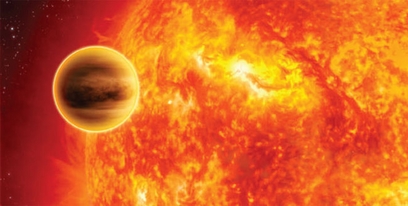
The odd, fiery planet is so close to its star and so large that it is triggering tremendous plasma tides on the star. Those powerful tides are in turn warping the planet's zippy less-than-a-day orbit around its star.
The result: an ever-closer tango of death, with the planet eventually spiraling into the star.
It's a slow death. The planet WASP-18b has maybe a million years to live, said planet discoverer Coel Hellier, a professor of astrophysics at the Keele University in England. Hellier's report on the suicidal planet is in Thursday's issue of the journal Nature.
"It's causing its own destruction by creating these tides," Hellier said.
The star is called WASP-18 and the planet is WASP-18b because of the Wide Angle Search for Planets team that found them.
The planet circles a star that is in the constellation Phoenix and is about 325 light-years away from Earth, which means it is in our galactic neighborhood. A light-year is about 5.8 trillion miles.
The planet is 1.9 million miles from its star, 1/50th of the distance between Earth and the sun, our star. And because of that the temperature is about 3,800 degrees.
Its size — 10 times bigger than Jupiter — and its proximity to its star make it likely to die, Hellier said.
Think of how the distant moon pulls Earth's oceans to form twice-daily tides. The effect the odd planet has on its star is thousands of times stronger, Hellier said. The star's tidal bulge of plasma may extend hundreds of miles, he said.
Like most planets outside our solar system, this planet was not seen directly by a telescope. Astronomers found it by seeing dips in light from the star every time the planet came between the star and Earth.
So far astronomers have found more than 370 planets outside the solar system. This one is "yet another weird one in the exoplanet menagerie," said planet specialist Alan Boss of the Carnegie Institution of Washington.
It's so unusual to find a suicidal planet that University of Maryland astronomer Douglas Hamilton questioned whether there was another explanation. While it is likely that this is a suicidal planet, Hamilton said it is also possible that some basic physics calculations that all astronomers rely on could be dead wrong.
The answer will become apparent in less than a decade if the planet seems to be further in a death spiral, he said.