Showing posts with label space. Show all posts

Monday, April 26, 2010

Aliens May Exist But Contact Would Hurt Humans: Hawking

LONDON (AFP) – Aliens may exist but mankind should avoid contact with them as the consequences could be devastating, British scientist Stephen Hawking warned Sunday.
"If aliens visit us, the outcome would be much as when Columbus landed in America, which didn't turn out well for the Native Americans," said the astrophysicist in a new television series, according to British media reports.

The programmes depict an imagined universe featuring alien life forms in huge spaceships on the hunt for resources after draining their own planet dry.

"Such advanced aliens would perhaps become nomads, looking to conquer and colonise whatever planets they can reach," warned Hawking.

The doomsday scenario is suggested in the series "Into the Universe with Stephen Hawking" on the Discovery Channel, which began airing in the United States on Sunday.

On the probability of alien life existing, he says: "To my mathematical brain, the numbers alone make thinking about aliens perfectly rational.

"The real challenge is to work out what aliens might actually be like."

Glowing squid-like creatures, herds of herbivores that can hang onto a cliff face and bright yellow predators that kill their prey with stinging tails are among the creatures that stalk the scientist's fantastical cosmos.

Mankind has already made a number of attempts to contact extraterrestrial civilisations.

In 2008, American space agency NASA beamed the Beatles song "Across the Universe" into deep space to send a message of peace to any alien that happens to be in the region of Polaris -- also known as the North Star -- in 2439.

But the history of humanity's efforts to contact aliens stretches back some years.

The US probes Pioneer 10 and 11 were launched in 1972 and 1973 bearing plaques of a naked man and woman and symbols seeking to convey the positions of the Earth and the Sun.

Voyager 1 and 2, launched in 1977, each carry a gold-plated copper phonogram disk with recordings of sounds and images on Earth.

Tuesday, August 18, 2009

Telescopes to Show Universe Soon After Big Bang


(CNN) -- It may not be possible to travel back in time, but seeing stars and galaxies as they looked millions or even billions of years ago is no problem thanks to telescopes, the closest thing we have to time machines.
Now, astronomers are holding their breath to see what they'll observe and discover with a new generation of huge telescopes set to be built around the world.

Peering ever deeper into space and further back in time, the powerful devices will be able to show what the universe was like when it was just a few hundred million years old and emerging from a period of total darkness after the Big Bang.
"[We'll be] looking at the first generation of stars forming in the universe, which is kind of a cool idea: The time when the lights went on in the universe. There was no light before that time," said Daniel Fabricant, associate director of the Harvard-Smithsonian Center for Astrophysics.

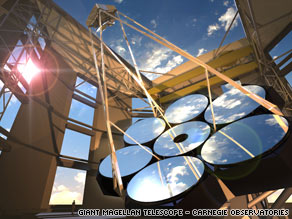
His institution is one of several research organizations and universities developing the Giant Magellan Telescope, to be built in Las Campanas, Chile, by 2018.

'Eye on the sky'

Bigger is better in the world of reflecting telescopes, which rely on primary mirrors to collect light. The bigger the primary mirror, the more light it can gather and the fainter the objects astronomers can see.

The world's largest optical and infrared telescopes have primary mirrors that measure about 10 meters (32 feet) across. But the Giant Magellan Telescope will more than double that diameter, with a monster primary mirror spanning almost 25 meters (80 feet).

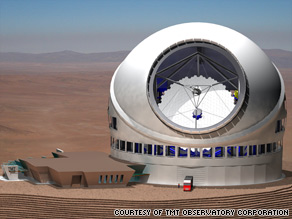
If the Magellan is the first new-generation star gazer to be built, it may not remain the record holder for long. Another consortium of organizations and universities is preparing to construct the aptly named Thirty Meter Telescope on the Mauna Kea summit in Hawaii, also scheduled for completion in 2018.

Wednesday, April 29, 2009

(CNN) -- Edo Berger got an alert early last Thursday morning when a satellite detected a 10-second blast of energy known as a gamma ray burst coming from outer space.
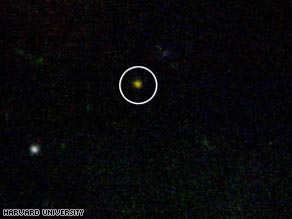

Telescopes around the world swiveled to focus on the explosion, soon picking up infrared radiation, which travels more slowly than gamma rays. Berger waited for the visible light which he expected to come next.

It never arrived.

"We were kind of blown away. We immediately knew what that meant," Berger said.

What it meant was that he was looking at the oldest thing ever spotted -- an enormous star exploding 13 billion years ago.

"At that point the age of the universe was only 600 million years," he said. In other words, Berger said, he was looking "95 percent of the way back to the beginning of time."

The star which exploded was 30 to 100 times larger than our own sun, and when it died, it gave off "about million times the amount of energy the sun will release in its entire lifetime," Berger told CNN by phone from Harvard University, where he is an assistant professor of astronomy.

Its death throes produced so much energy that "momentarily, we can essentially see it anywhere in the universe," Berger said.

The object, known as GRB 090423, is about 200 million years older than the previous record-holder for oldest object ever seen.

Berger isn't just interested in the record books, though -- the gamma ray burst extended the frontiers of human knowledge about the history of the universe.

"We learn that already massive stars were around 600 million years after the universe formed," Berger said. "We suspected that, but now we have proof. Now that we know these objects are so bright, in the next few years we should be able to pinpoint exactly at what stage in the evolution of the universe stars and galaxies formed."

"There are theories" about when that happened, Berger said, "But they are all over the place. People let their imaginations run wild."

Given the discovery last week -- which was announced Tuesday -- Berger thinks it is possible that he will soon have a clear answer.

"If we talk in a few years, hopefully I would be able to tell you exactly when that happened," he said.

The gamma radiation from GRB 090423, which took 13 billion years to reach earth, was detected by a NASA satellite called Swift. The infrared radiation was detected by the Gemini Observatory in Hawaii.

Friday, April 24, 2009

This Day In History


Apr 24 1967
Cosmonaut Vladimir Komarov soon becomes the world's first space mission fatality after his Soyuz parachutes become entangled four miles above the Earth.


Apr 24 1995
The Unabomber strikes, killing a timber industry lobbyist. Gilbert Murray is killed in his Sacramento office, opening mail addressed to the man he replaced.


Apr 24 1997
A petri dish arrives in an 8x10 manila envelope at the Washington, D.C. offices of B'nai B'rith International. The dish, labeled "anthracks," drips a liquidy red gel which is later determined to contain a relatively harmless strain of Bacillus cereus.

Tuesday, April 14, 2009

This Day In History


Apr 13 1970
56 hours and 205,000 miles from planet Earth, the crew aboard Apollo 13 hears "a pretty loud bang" when oxygen tank number two spontaneously explodes. Astronaut Jack Swigert informs Mission Control in Houston: "Hey, we've got a problem here." Miraculously, the crew manages to return home in their crippled spacecraft.


Apr 13 1982

David Crosby of Crosby, Stills, Nash, and Young is arrested while freebasing cocaine and for illegal possession of a .45 handgun. Sentence: 5 years.

Saturday, March 14, 2009

New NASA Mission

Let's cross our fingers and hope this mission is successful.

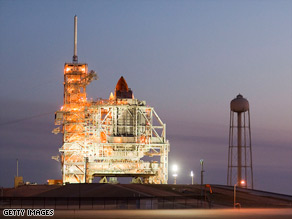
(CNN) -- The space shuttle Discovery is on pace for a Sunday launch after NASA engineers repaired a leaky gas venting system, officials said Saturday. The leak had canceled a planned launch on Wednesday.

NASA hopes the seven-member crew can take off around 7:40 p.m. Sunday on a mission to the international space station, where they will deliver supplies needed to expand the station's crew to six people.
"The vehicle is looking real good ... ," lead shuttle flight director Mike Moses said. "Basically, I think I can sum this up by just saying we're good to go tomorrow and we're looking forward to getting the count going."
A leak in a hydrogen gas vent line forced Wednesday's delay. Repairs went smoothly, Moses said.

The line funnels flammable hydrogen away from the launch pad during takeoff.
The shuttle crew will be delivering the final parts needed for an expanded solar energy power system that will allow the station to double its crew to six people. The crew also will be dropping off Japanese astronaut Koichi Wakata, who will replace NASA's Sandy Magnus on the space station.
The shuttle also will carry a replacement for a failed unit in a system that converts urine to drinkable water, NASA said.
Kathy Winters, the mission's chief weather officer, said Sunday appears to offer only a 20 percent chance of weather that would scrub the launch.
The crew, led by commander Lee Archambault, is expected to board Discovery at Kennedy Space Center at Cape Canaveral, Florida, at about 4:30 p.m. Sunday.

Officials said the crew has been training and resting for the mission since Wednesday.
Earlier this week, Magnus, station commander Michael Fincke and Russian engineer Yury Lonchakov had to take shelter in their Soyuz spacecraft -- a lifeboat of sorts -when a piece of debris from an earlier mission hurtled uncomfortably close to the station.

The debris, moving about 20,000 mph, came within three miles of the station but caused no damage.
Wednesday's launch postponement was the latest in a series of delays for Discovery as it tries to make the 28th shuttle mission to the space station.
The launch had been delayed previously to allow time to check a "flow-control valve in the shuttle's main engines," NASA said last week. That resulted from damage being found in a valve on the shuttle Endeavour during its November 2008 flight. Three valves were cleared and installed on Discovery, it said.

Wednesday, March 4, 2009

Out of This World..

PASADENA, Calif. (AP) — An asteroid about the size of one that leveled more than 800 square miles of forest in Siberia a century ago just buzzed the Earth. The asteroid named 2009 DD45 was about 48,800 miles from Earth when it zipped past early Monday, NASA's Jet Propulsion Laboratory reported.

That is just twice as high as the orbits of some telecommunications satellites and about a fifth of the distance to the Moon.

"This was pretty darn close," astronomer Timothy Spahr of the Harvard-Smithsonian Center for Astrophysics said Wednesday.
But not as close as the tiny meteoroid 2004 FU162, which came within 4,000 miles in 2004.
The space rock measured between 69 feet and 154 feet in diameter. The Planetary Society said that made it about the same size as the asteroid that exploded over Siberia in 1908.
Scientists at the Siding Spring Observatory in Australia spotted 2009 DD45
and began tracking it in late February when it was about 1 million miles away.

Spahr said he knew within an hour of that discovery that it would pose no threat to Earth.

Of the known space rocks, the next time an object will get closer to Earth will be in 2029 when an 885-foot asteroid called 99942 Apophis comes within 20,000 miles, said Donald Yeomans of NASA's Near-Earth Object Program at the Jet Propulsion Laboratory in Pasadena.

Last year, the asteroid 2008 TC3 harmlessly burned up in Earth's atmosphere over Africa 19 hours after it was discovered. Astronomers gave a six-hour notice warning of that fiery plunge.