Showing posts with label fbi. Show all posts

Friday, December 17, 2010

Remains Found on Long Island Aren't Those of Missing Woman

New York (CNN) -- Searching for clues to the disappearance of a missing woman, authorities made a grisly discovery: the bodies of four women in various stages of decomposition, stuffed into bushes along an isolated strip of waterfront property on Long Island.

But the remains of Shannon Gilbert, the woman they sought, weren't there, the Suffolk County (New York) Medical Examiner's Office said Thursday.

Gilbert, 24, of Jersey City, New Jersey, was last seen alive on May 1, CNN affiliate WABC reported.

Suffolk County Detective Lt. Gerard Pelkofsky told WABC that Gilbert worked as a prostitute and had last arranged to meet a client on Fire Island about a mile from Oak Beach, where the bodies were found, he said.

"Common sense tells us it's not a coincidence," Pelkofsky said.

A Long Island resident -- who lives a few miles from where the bodies were found -- said a young woman who "looked like she was partying all night" came to his door at about 5 a.m. on May 1.

"She was screaming 'Help me, help me!' and said somebody was chasing her," said Gustav Coletti, who lives in the town of Oak Beach.

He described the woman as a "young, light-brown-haired person in her early 20s."

Coletti said he called 911 after opening his front door to the woman, prompting her to flee into the weeds along an embankment near his house.

Moments later, Coletti said, an Asian man driving a dark-colored sport utility vehicle pulled up alongside his home, looking for the woman.

"Things got out of hand at a party and I'm just looking for her," Coletti quoted the man as saying.

When Coletti informed him that he had called the police, the man said that he "should not have done that" and drove off in the direction of where girl had fled, Coletti said.

Authorities were searching in the area on Saturday when they found the first body, and three more were found Monday, Suffolk County police said.

All were discovered on a quarter-mile stretch of Oak Beach, "which indicates they were dumped there by the same person or persons," Suffolk County Police Commissioner Richard Dormer said. "It's too coincidental that there were four bodies in the same location."

Investigators broadened the search Thursday, but no additional remains were found, according to Suffolk County Police.

Dormer said police could be dealing with a serial killer but have not been able to sufficiently link the bodies to make that determination.

Federal agents have joined police in their Investigation, according to Dormer.

"I held a meeting between members of my staff and the FBI's New York office today concerning the discovery of four bodies in Gilgo Beach during the past several days," Dormer said Wednesday. "The FBI has offered all available resources in support of our investigation."

The FBI was not immediately available for comment.

Authorities say investigators will continue to search the surrounding area Friday.

Tuesday, August 25, 2009

FBI Puts Brazen Bandit's Face on Billboards

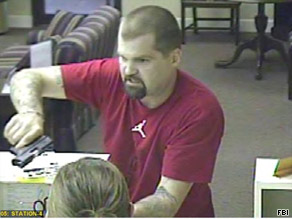
(To me, he kinda looks like that actor from the Dave Chappelle Show, lol)

(CNN) -- He has been captured by bank surveillance cameras in four states, sneering and holding a pistol sideways during heists.

Now authorities hope to catch the serial bank robber by plastering his image on electronic billboards throughout the South.

The FBI is searching for the suspect, who they say has robbed at least 10 banks in Kentucky, North Carolina, South Carolina and Tennessee.

"This is a unique instance in which the subject in these bank robberies has not used a mask ... or any type of a gimmick," FBI agent Kevin Keithley said Tuesday in Johnson City, Tennessee. "It is really uncommon just to come into a bank and show his face like he has."

The brazen bandit has been captured in surveillance footage sporting the same close-cropped hairstyle and goatee in many of the holdups. He does not seem to make any effort to cover his face and sometimes is seen aiming a handgun sideways, showing his tattoos on both forearms as he gestures at bank employees.

The FBI has mapped the bank robber's path on a map that crisscrosses the southern United States.

The billboard that went up Monday roughly follows the path that bank robber took, the FBI said.

His odyssey has spanned more than 600 miles north, from Charleston, South Carolina, to Louisville, Kentucky, and about 500 miles east, from Knoxville, Tennessee, to Edenton, North Carolina.

The robberies started in May and the most recent one was last week in Tennessee, Keithley said.

The suspect has not yet harmed anybody in the robberies, but the FBI considers him extremely dangerous.

"This guy has made no effort to hide the gun," Keithley said . "He has threatened the use of it in every bank robbery that he has committed. He has put the gun in the faces of tellers, threatened to use the gun against them.... So certainly we need to get this guy in custody before he does harm someone."

The suspect is described as white, about 25 years old, 5 feet 9 to 5 feet 11, 170 to 175 pounds. He has short, reddish-brown hair and an unshaven goatee, the FBI said.

The bureau asks anybody who knows the bank robber to call 423-282-8090.

Wednesday, August 19, 2009

Unraveling the Mysteries of Thousands of Cold Cases

CNN Blogs- Last week, a young man hours away from starting a new job took a bike ride in Lubbock, Texas, and hasn’t been seen since.

Decades earlier, on March 15, 1967, the remains of a woman clad in a blue dress and white shoes were discovered in a field in Baltimore.

The two cases are separated by nearly 2,000 miles and more than 42 years. Yet they share a common bond: they have never been solved.

There is now another, more hopeful connection. They are just two of thousands of cold cases and now all of them can be found on a single free web site that is funded by the federal government. It is designed to help law enforcement agencies and medical examiners across the country unravel the mysteries. It also gives countless families a place to look for loved ones and a chance to find answers and peace of mind.

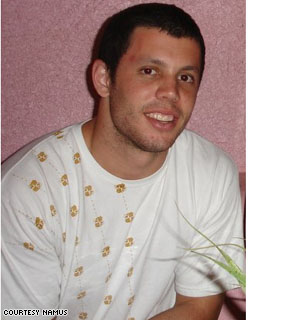
It is the National Missing and Unidentified Persons System. Known as NamUS, the site offers what may be the most comprehensive public search engine to date for this undertaking. “With advances in forensic sciences, there is always the possibility of closing an old case,” NamUS Operations Manager Billy Young told CNN. “No matter how old the records are, we have someone looking at them.”


NamUS, which was launched in 2007, was commissioned for the National Institute of Justice. It is operated by the National Forensic Science Technology Center, located in Largo, Florida.

In an email to CNN, Christine Vivian, the organization’s communications director, explained the genesis behind NamUS, writing it “was created to address the issue of the estimated 40,000 unidentified dead nationwide, and give families a tool to assist in finding missing adults.”

“As more cases are entered into the system, more people in every area – law enforcement, victim advocacy and the general public can become part of the conversation that will resolve cases.”

The missing persons database contains 1,996 individual files, of which more than 92 percent remain open – including the disappearance of that young man in Lubbock. His name is William Bradley Klosterman. Known as Brad, the 20-year-old hopped on his new Fuji bike around noon on August 11. He said he was going to visit a friend. He left without taking his i.d., his wallet, or cell phone.

Klosterman was last seen wearing black mesh running shorts and a black-t-shirt with the word “Southlake” on the front. He also has a small scar on the outside of his right eye and a tattoo that says “Psalm 23″ on his right arm. Authorities believe he may have been traveling to California.

It is the same theory that investigators had nearly half a century ago with the disappearance of Lyndal Ashby. On October 23, 1960, the 22-year-old Ashby vanished in Hartford, Kentucky. As with the other cases in NamUS, the file on Ashby includes police contact information.

The NamUs National Unidentified Decedent Data System lists 5,564 cases. But only 147 have been closed. The woman in the blue dress is not one of them. Her skeletal remains were found in a Baltimore field in the winter of 1967, but forensic experts believe she probably died the previous year. She was 5′3″ and between the ages of 21 and 45.

The file on the woman’s case is limited. However, there are thousands of other entries for both NamUs databases that have detailed information on condition and physical characteristics, clothing, accessories, police reports, photographs, and dental charting.

Case #5593 is a representative example. A man believed to be in his thirties was found intoxicated and unconscious on the ground in Queens, New York on May 31 of this year. He was taken to a hospital where it was determined he suffered a traumatic brain injury. He died on June 3.

The man, who had black hair and was wearing blue jeans, had several scars on his body. He was also missing part of his right second finger.

Perhaps he had children, or maybe a wife waiting for him at home. Nobody knows for sure. But there is probably someone who wants to know what happened to that man. And they are joined by many others throughout the country. With NamUS, they all have somewhere to which they can turn.

“It lets them know that someone is constantly looking for their loved ones and they are not being forgotten, Billy Young said to CNN. “It gives them hope that one day they will be able to get closure.”

Tuesday, June 9, 2009

Wife: FBI Didn't Rule Out Foul Play in Cruise Disappearance

So strange to now read about this on Greenwich Time's website, my uncle and I were talking about this case one night on our trip to Florida- my uncle knows some of George's friends and said he was drinking absynthe that night, and really fell over the balcony on his own accord, and that his chair was left right out near the rail to indicate he was sitting there, as well.

Greenwich Times - Four years after Greenwich resident George Smith IV went missing on a honeymoon cruise, his widow continues to maintain the incident may have been an accident.

However, testimony unsealed Monday reveals that one of Jennifer Hagel Smith's own attorneys believes Smith died as the result of foul play.

"My belief, I think that there was foul play. I've always thought that," said attorney James Walker, the maritime attorney for Hagel Smith.

"And as I go through this case, I'm concerned that there is foul play. I don't believe in coincidences."

Smith was on a Royal Caribbean Mediterranean cruise in 2005 when he went missing. His body was never found, although there were blood stains on an overhang below the couple's private
balcony aboard the Brilliance of the Seas ship. The newly released testimony stems from a 2008 probate court battle in which Smith's family was contesting a settlement reached between his widow and the cruise line.

During his testimony, Walker pointed the finger at four men who were last seen with Smith the night he vanished as potential suspects.

"If anyone was involved in foul play, it was going to be one of those four men," Walker said.

The 2008 testimony also zeroed in on a meeting between the two families and the Department of Justice where U.S. Attorney Peter Jongbloed allegedly told Hagel Smith that his office believed foul play likely was involved.

Attorney Michael Jones, who represents the Smith family, grilled Hagel Smith about what was said at the meeting.

Under cross-examination, Jones asked Hagel Smith, "Do you recall Mr. Jongbloed actually interjecting and looking right at you and saying, 'Jennifer, we also believe there was foul play' -- meaning the Department of Justice and the FBI?"

Hagel Smith said, "No, he said, "If we didn't think there was a possibility of foul play or something, then we wouldn't be investigating this."

Jones continued, saying, "You don't recall him saying that they felt there was actually -- that it really wasn't an accident, that there was something that happened that was more along the lines of foul play?"

Hagel Smith replied, "Well, I mean, it's kind of -- because what I took from that is also the fact they said they didn't have anything pointing at somebody or in the specific direction."

Jones declined comment on that dialogue.

Hagel Smith's father, John Hagel, said Monday the FBI told his family they believe it is a 50/50 scenario whether Smith died of foul play or from an accident.

"The FBI and the U.S. attorney's office are not going to commit to an opinion either way," Hagel said. "They are on the fence, that's what we were told. At the same time, they have not been able to provide us any evidence of foul play."

However, Jones said the Smith family is certain their son was killed.

"The Smith family believes there was foul play," Jones said. "The FBI investigation is open and active, which means they must believe it was more than an accident."

After Smith's disappearance, a divide formed between the two families, particularly after Hagel Smith accepted a $1.1 million settlement with the cruise line, which the probate court upheld despite an outcry from Smith's family, who claimed their son was worth more. The Smith family has alleged that Hagel Smith rushed to settle to avoid embarrassing details coming to light about her behavior the night Smith vanished.

Hagel's family said the probate court validated their daughter's settlement, noting it was reasonable. An appeal of the probate court's decision is pending in state Superior Court in Stamford.

"The Smiths continue to let their emotions cloud facts in this case that cannot be disputed," Hagel said. "The Smiths will not even consider the possibility that George's use of prescription drugs and alcohol could have played a role in his death."

Jones pointed out that the Hagels have no evidence Smith was using prescription drugs, as evidenced by their testimony.

While the FBI has not released any information pertaining to their investigation, as is customary for the agency, Jones said his clients are hopeful that justice will prevail.

"The Smith family is very grateful for the work the FBI and Department of Justice have done in the case," Jones said. "We are very hopeful their continued good work will result in them identifying George's killer."

-- Staff Writer Debra Friedman can be reached at debra.friedman@scni.com or 625-4439.

S.F. Police Department Holds Up Zodiac Case

CBS13--CBS13 has uncovered a major roadblock in the FBI's investigation into the legendary Zodiac case. It's a lack of cooperation, not from a person, but from a police department.

The FBI began collecting DNA evidence last year, and now CBS13 knows why there are no results. The police agency that has most of the original evidence isn't sharing. There may also be another roadblock. The FBI has in their possession a copy of a report alleging someone made changes to what are supposed to be authentic Zodiac letters.`

The changes are subtle.

The Zodiac had seven victims in Northern California. In numerous letters, the psychotic killer revealed details of the attacks, taunted police and threatened to carry out more murders.

Dennis Kaufman claims his efforts to prove his late step father, Jack Tarrance, is the Zodiac uncovered changes to what are supposed to be copies of authentic Zodiac writings.

"They are different significantly," says Kaufman.

The theory is now capturing the interest of the FBI.

CBS13 has learned agents are looking at a report complied by Nanette Barto.

Barto is a forensic document examiner. She believes she identified dozens of similarities in the writings of Jack Tarrance and the Zodiac, and discovered the changes.

Barto believes an entire Zodiac letter was painstakingly traced.

"At the bottom of each of these letters, where you see these heavy little dots, indicators of somebody writing slow and coming to a stop, almost as if they didn't want to overshoot it or add anything extra to it," explains Barto.

The tracing, Barto believes, is an effort to make the ink throughout the letter consistent, trying to hide a single alteration.

"I believe the 'a' in watch was altered, this previously had a bell top 'a'," says Barto.

The lines blend together, but when compared to an older copy, the bell top or hood over the 'a' appears to have been removed.

Barto claims to have uncovered several cases of altered a's.

Changing a single letter may not appear significant, but in the world of handwriting analysis it can be crucial.

"One missing similarity can outweigh all similarities found," according to Barto. Meaning, Jack's Tarrance's a's were so distinctive, most containing that extra line above that never finding one could create doubt.

"Does it look like someone intentionally altered the letters," asked CBS13 reporter Kris Pickel.

"Absolutely," says Barto.

Dennis claims the changes began to appear after he showed his stepfathers handwriting to the San Francisco police department in 2001, and posted samples on the internet.

Who made the changes is unknown, but where they showed up is clear.

"We know in Graysmith's books they've been altered as well as Tom Voight's website," claims Kaufman.

An author and a webmaster, Tom Voight runs Zodiackiller.com. The site says it's committed to archiving all case related material.

The changes are also found in print.

Robert Graysmith wrote two books, 'Zodiac' and 'Zodiac Unmasked.' The books were the basis for the 2007 movie "Zodiac."

Both books contain the same Zodiac letter, but are clearly not the same. Numerous markings were removed.

The text could have been cleaned up to make the letter easier to read, but why change the 'a'? Was it intentional or perhaps improvements in the quality of the copies?

CBS13 made calls and emails to inquire which is the true text to Voight, but did not get a response. CBS13 was unable to contact Greysmith.

Handwriting is one piece of a much large puzzle the FBI is assembling to determine if Jack Tarrance and the Zodiac are one in the same.

Last August, the agency began running DNA tests on multiple items turned over by Dennis Kaufman, including a hood similar to one worn by the Zodiac.

If handwriting plays an important role, why wouldn't the FBI go straight to the originals?

CBS13 has uncovered what has been slowing down the FBI investigation: The San Francisco Police Department.

The FBI has been asking since the year 2000, nine years, to view the police department's evidence, so far they've been shut out.

Only one Zodiac murder was committed in San Francisco, but the department has the majority of the Zodiac letters and the only partial DNA profile of the killer.

The San Francisco Police Department denied our multiple phone and email requests for an interview, specifically asking if they will allow the FBI to examine their evidence.

And although the department has shown the evidence to reporters in the past, our requests to see what evidence still exists were shot down.

Thursday, June 4, 2009

FBI Joins Hunt for Killer Who Leaves Taunting Notes

(CNN) -- The 5-year-old girl found the note tucked inside a plastic bag and left in a basket used as a flower pot.

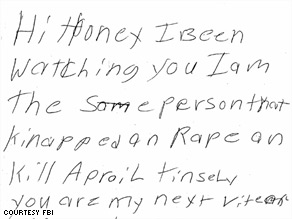
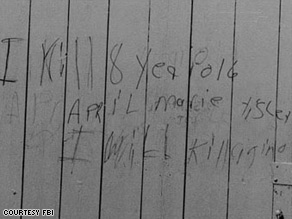
"Hi Honey I Been watching you," it said. "I am the same person that kidnapped an Rape an kill Aproil tinsely here is a present foR yo you are my next vitem."

A used condom was stuffed in the bag alongside the note.

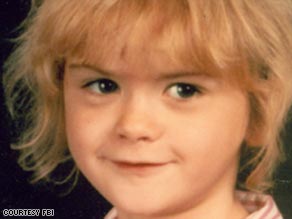
It was March 2004 -- nearly 16 years after 8-year-old April Tinsley was abducted from a Fort Wayne, Indiana, neighborhood, raped and killed.

Her killer remains at large, and police believe he has surfaced several times, scrawling a message in crayon on a barn in 1990, then leaving four chilling notes for children in the Fort Wayne area years later.

Indiana authorities are now asking an FBI task force -- the Child Abduction Response Deployment (CARD) team -- to help take a fresh look at the case.

"Investigators believe the case is 'highly solvable,' and after 21 years, their desire to bring April Tinsley's killer to justice is stronger than ever," the FBI said.

CARD teams were created three years ago, aimed at bringing together "a variety of experts in child abduction cases who could quickly respond on the ground to help local authorities with time-sensitive investigations," the FBI said.

While CARD responds to abductions and disappearances, the team also works cold cases, like April's, the agency said. "As team members discovered, there is enough evidence -- including notes, pictures, and DNA left by the killer years after the murder -- to make investigators hopeful they can break the case."

The team includes behavioral profilers, agents and analysts from the FBI's Crimes Against Children Unit and coordinators and representatives from the National Center for the Analysis of Violent Crime and the Violent Criminal Apprehension Program.

April Marie Tinsley was playing outside with friends on Good Friday, April 1, 1988. As the three girls were moving from one friend's home to another's, the first-grader realized she had left her umbrella behind and went back to get it.

She never returned. Her body was found three days later, in a ditch some 20 miles northeast of the Tinsley home. April's body was clothed, but an autopsy showed she had been raped and suffocated.

Two years later, a teenage boy called police to report a message scrawled in crayon and black marker on the front doors of a barn about 10 miles from April's home. He never saw the writer, according to the TV program "America's Most Wanted," which profiled the case in May, but each day noticed the print was getting darker and more pronounced.

Although the message was hard to read, the person wrote he had killed April, and that he would kill again. Crayons were left behind at the scene, "America's Most Wanted" said on its Web site. Police attempted to conduct forensic analysis on them, but came up empty.

Then, in spring 2004, the four notes appeared at various Fort Wayne homes, several of them placed on bicycles that young girls had left in their yards. All the notes were written on lined yellow paper and placed inside plastic bags along with used condoms or Polaroids of the killer's body, the FBI said. Several notes referred to April.

Authorities have reason to believe the writer of the 1990 note also left the notes 14 years later, Fort Wayne police said. "That tells us that the person's still around, still out there," said Fort Wayne police Capt. Paul Shrawder.

"It's definitely very odd," he added. "Even the FBI is puzzled by the behavior, that the letters would come out so many years later and then nothing again."

DNA evidence was recovered from April's body and from the condoms, Shrawder said. While police have no one to match it with at this point, "things have been resubmitted and retested" as technological advances have been made, he said.

The advantage of the CARD team, from a local police standpoint, is that members only work such cases, while "we're local -- we work on whatever happens here," Shrawder said. The team has experience in such matters, and might look at new aspects, angles and possibilities that local authorities haven't thought of, he said.

Federal investigators were deployed to Fort Wayne to work the Tinsley case earlier this month. After the "America's Most Wanted" profile and the renewed push, authorities received between 400 and 500 tips, Shrawder said. Some could be ruled out right away -- someone who had died between the murder and the 2004 notes, for instance, he said. DNA samples were taken on about 150 people.

Police are still trying to run down about 50 or 75 tips, he said. "That was the purpose, was to go out and run down every single one of these, no matter how vague it was."

Some of the authorities' leads, according to the FBI, include identifying Fort Wayne residents who used Polaroids as late as 2004; tracking down a green paisley bedspread similar to that seen in one Polaroid; and looking at misdemeanor offenses in the area near the time of April's death and the 2004 note spree, as offenses like indecent exposure could indicate more serious sex crimes.

In addition, the FBI has released a behavioral profile of Tinsley's killer. Police believe he is a white male currently in his 40s or 50s who prefers and desires sexual contact with children, particularly little girls.

"This offender has demonstrated that he has strong ties to northeast Fort Wayne and Allen County," the profile said. "This is where he likely lives, works and/or shops. You may be standing next to him in line at the grocery store, sitting beside him in the pew at church, or working beside him on the production line."

Such profiles can be helpful in that they might spur local residents to tell police, "You know, I always wondered about this one guy," Shrawder said.

To offer information on the Tinsley case, contact your local FBI office or Fort Wayne police at (866) 602-7745.

Saturday, May 2, 2009

Caylee's Hair Negative For Variety Of Drugs

An FBI lab report released among hundreds of pages of documents made public Friday in the case against Casey Anthony showed hair samples from her daughter's remains revealed negative results for a variety of drugs.

Examiners did not detect alprazolam, known under the trade name Xanax, or diazepam, marketed as Valium, according to the report.

The hair samples were not tested for chloroform, "as this examination is not deemed probative by the FBI Laboratory's Chemistry Unit."

"Although the method used in this analysis allows for the detection of very small amounts of the drugs listed, negative results should not be interpreted as proof that the individual was not exposed to the drugs listed," the report stated.

Anthony, 23, is charged with first-degree murder in the death of 2-year-old Caylee. Six months after Caylee disappeared, the toddler's skeletal remains were found Dec. 11 in a wooded area less than a mile from her east Orange County home.

The bulk of the documents released Friday focused on the discovery of Caylee's remains and why she wasn't found four months earlier, in August.

Orange County meter reader Roy Kronk found Caylee's skeletal remains while on his route. That discovery, however, came after he alerted detectives multiple times about a suspicious bag in the woods in August. One deputy — later identified as Orange County Deputy Richard Cain — failed to follow through on a tip.

The Orange County Sheriff's Office is in the process of firing Cain, whose actions and job performance were the subject of an internal investigation in the wake the discovery. He is appealing the decision.

"You failed to thoroughly investigate the call for service which ultimately delayed the discovery of the remains of Ms. Caylee Anthony," Capt. Larry D. Krantz wrote in the March 30 internal-investigation report.

Amy L. Edwards of the Sentinel staff contributed to this report. Sarah Lundy can be reached at slundy@orlandosentinel.com or 407-420-6218.

Friday, May 1, 2009

Caylee's Hair SamplesTested Negative for Drugs

The state attorney's office released more documents in case against Casey Anthony, including FBI Lab reports and a report from the US Fish & Wildlife on "snake" found near the scene where Caylee's remains were discovered.

In one of the reports hair samples taken from Caylee's remains were tested for a various drugs. The results were negative.

"Although the method used in this analysis allows for the detection of very small amounts of the drugs listed, negative results should not be interpreted as proof that the individual was not exposed to the drugs listed," report released stated.