Showing posts with label cocaine. Show all posts

Friday, August 28, 2009

The World's First Cocaine Bar

Uh-oh! This doesn't sound good.

"Tonight we have two types of cocaine; normal for 100 Bolivianos a gram, and strong cocaine for 150 [Bolivianos] a gram."

The waiter has just finished taking our drink order of two rum-and-Cokes here in La Paz, Bolivia, and as everybody in this bar knows, he is now offering the main course. The bottled water is on the house.

The waiter arrives at the table, lowers the tray and places an empty black CD case in the middle of the table. Next to the CD case are two straws and two little black packets. He is so casual he might as well be delivering a sandwich and fries. And he has seen it all. "We had some Australians; they stayed here for four days. They would take turns sleeping and the only time they left was to go to the ATM," says Roberto, who has worked at Route 36 (in its various locations) for the last six months. Behind the bar, he goes back to casually slicing straws into neat 8cm lengths.

La Paz, Bolivia, at 3,900m above sea level – an altitude where even two flights of stairs makes your heart race like a hummingbird – is home to the most celebrated bar in all of South America: Route 36, the world's first cocaine lounge. I sit back to take in the scene – table after table of chatty young backpackers, many of whom are taking a gap year, awaiting a new job or simply escaping the northern hemisphere for the delights of South America, which, for many it seems, include cocaine.

"Since they are an after-hours club and serve cocaine the neighbours tend to complain pretty fast. So they move all the time. Maybe if they are lucky they last three months in the same place, but often it is just two weeks. Route 36 is a movable feast," says a Bolivian newspaper editor who asked not to be named. "One day it is in one zone and then it pops up in another area. Certainly it is the most famous among the backpacker crowd but there are several other places that are offering cocaine as well. Because Route 36 changes addresses so much there is a lot of confusion about how many cocaine bars are out there."

This new trend of 'cocaine tourism' can be put down to a combination of Bolivia's notoriously corrupt public officials, the chaotic "anything goes" attitude of La Paz, and the national example of President Evo Morales, himself a coca grower. (Coca is the leaf, and cocaine is the highly manufactured and refined powder.) Morales has diligently fought for the rights of coca growers and tossed the US Drug Enforcement Agency (DEA) out of Bolivia. While he has said he will crack down on cocaine production, he appears to be swimming against the current. In early July, the largest ever cocaine factory was discovered in eastern Bolivia. Capable of producing 100kg a day, the lab was run by Colombians and provided the latest evidence that Bolivia is now home to sophisticated cocaine laboratories. The lab was the fourth large facility to be found in Bolivia this year.

Nowhere in South America is cocaine production growing faster than Bolivia. Reports by the UN show that in Colombia, production dropped 28% last year [2008], while in Bolivia it rose nearly 10%. "There is more interest and and investment in purifying coca paste here and exporting it, rather than sending it to Colombia for purification," Oscar Nina, Bolivia's top anti-drug official, said recently.

As the US and Colombian military put pressure on drug traffickers, operations are migrating into nearby countries, especially Bolivia, where the turf for illegal operations is as fertile as the valleys where the locals have grown coca for the last five centuries. Stopping cocaine tourism in La Paz could be as difficult as keeping Americans from drinking during prohibition.

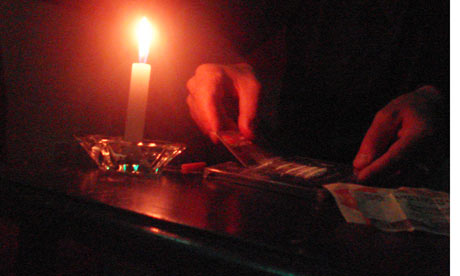
Down in Route 36's main room, the scene is chilled. A half-hearted disco ball sporadically bathes the room in red and green light. Each table has candles and a stash of bottled water, plus whatever mixers one cares to add to your drink. In the corner, a pile of board games includes chess, backgammon, and Jenga, the game in which a steady hand pulls out bricks from a tower of blocks until the whole pile collapses. If it weren't for the heads bobbing down like birds scouring the seashore for food, you would never know that huge amounts of cocaine were being casually ingested. There's a lot of mingling from table to table. Everyone here has stories – the latest adventures from Ecuador, the best bus to Peru – and even the most wired "why-won't-he-shut-up?" traveller is given a generous welcome before being sent back to his table, where he can repeat those stories another 10 times.

"Everyone knows about this place," says Jonas, a backpacker who arrived two days earlier. "My mate came to Bolivia last year and he said, 'Route 36 is the best lounge in all of South America.'" It is certainly the most bizarre and brazen. Though cocaine is illegal in Bolivia, Route 36 is fast becoming an essential stop for thousands of tourists who come here every year and happily sample the country's cocaine, which is famous for both its availability, price (around €15 a gram) and purity.

The scene here is peaceful; there seems no fear that anyone will be caught. ("The owner has paid off all the right people," one waiter says with a smile.) A female backpacker from Newcastle slips on to one of the four couches arranged around the table. "We've brought some [cocaine] virgins here. This will be their first time, so we are just rubbing it on their lips. But they are lucky – you could never get such pure coke back home. In London you pay 50 quid for a gram that's been cut so much, all it does it make your lips numb and sends you to the bathroom."

Travellers' blogs also give the place a good writeup. "I travelled the world for nine months, and for sure La Paz was the craziest city and Route 36 the best bar of my entire trip," writes one, while another says, "Like to burn the candle at both ends? Well, here you can bloody well torch the whole candle."

And torch your brain as well. Cocaine, as everybody knows, is highly addictive, destructive and easy to abuse. The rationale for outlawing cocaine was to protect public health – but instead the now 40-year experiment in prohibition has done little to protect the lives of millions of users worldwide who will snort whatever white substance is placed before them. The billions in annual profits have corrupted governments worldwide, and La Paz, without intending it, seems to have mutated into the front line of this failed drug war.

Saturday, August 8, 2009

Autopsy: Cocaine a Factor in Billy Mays' Death

(CNN) -- An autopsy report issued Friday by Hillsborough County, Florida, cites cocaine as a contributing factor in the death of TV pitchman Billy Mays, who died in June at age 50.

"Mays died from a lethal arrhythmia of the heart caused by hypertensive and arteriosclerotic heart disease," the county said in a statement attributed to Dr. Leszek Chrostowski, the associate medical examiner who conducted the autopsy.

"He further concluded that cocaine use caused or contributed to the development of his heart disease, and therefore contributed to his death," it added.

The fact that toxicology tests detected only breakdown products of cocaine, not the drug itself, led Chrostowski to conclude that Mays had used cocaine "in the few days prior to death but not immediately prior to death."

Cocaine is a stimulant that can raise blood pressure and thicken the wall of the left ventricle of the heart, one of the organ's four main pumping chambers.

The autopsy also found low concentrations of ethyl alcohol "consistent with social consumption of a few beverages" as well as the narcotic drugs hydrocodone, oxycodone and tramadol. Mays had prescriptions for the drugs -- which were found in therapeutic or subtherapeutic concentrations -- to ease hip pain.

In addition, the tests found evidence of two tranquilizers -- alprazolam (Xanax) and diazepam (Valium) -- which are commonly prescribed for a variety of ailments, including anxiety and insomnia. Both drugs were determined to be in therapeutic or subtherapeutic concentrations.

Mays was found dead at his home near Tampa on June 28.

Mays, with his booming voice, was famous for fronting products such as OxiClean and Orange Glo in TV commercials.

Friday, June 26, 2009

Mom Who Abandoned Baby In Shoebox Arrested

HEMPSTEAD, N.Y. (WPIX) - Bail has been set at a half a million dollars for the Long Island mom accused of abandoning her newborn in a shoebox in the lobby of a Hempstead apartment building.

Xiomara Gamez, 25, was arraigned on charges of reckless endangerment, child abandonment and child endangerment at First District Court in Hempstead. She pleaded not guilty to the charges.

Prosecutors say Gamez has a drug addiction and has six other children who live with their father. They say she admitted to being addicted to cocaine during her latest pregnancy.

The newborn infant nicknamed "Baby Hope" by authorities was left "completely soiled" in a Timberland box on the floor of an apartment lobby at 5 Lafayette Ave. on Sunday, according to prosecutors.

Judge Robert Bruno ordered Gamez held on $500,000 bond or $250,000 cash bail as she faces charges of first-degree reckless endangerment, abandonment of a child and endangering the welfare of a child.

Gamez abandoned the newborn girl, nicknamed Baby Hope, "because of her addiction" to drugs, the prosecutor said. Authorities said the newborn was in good health when she was found with her umbilical cord tied off with dental floss.

After an investigation Nassau County detectives found Gamez and arrested her Wednesday.

Gamez is set to appear back in court on Tuesday.

Previous Article:
http://krystle-ann.blogspot.com/2009/06/police-search-for-mother-of-abandoned.html

Tuesday, June 9, 2009

Submarines Ferry Colombian Blow

MEXICO CITY -- When anti-narcotics agents first heard that drug cartels were building an armada of submarines to transport cocaine, they thought it was a joke.

Now U.S. law enforcement officials say that more than a third of the cocaine smuggled into the United States from Colombia travels in submersibles.

An experimental oddity just two years ago, these strange semi-submarines are the cutting edge of drug trafficking today. They ferry hundreds of tons of cocaine for powerful Mexican cartels that are taking over the Pacific Ocean route for most northbound shipments, according to the Colombian navy.

The sub-builders are even trying to develop a remote-controlled model, officials say.

"That means no crew. That means just cocaine, or whatever, inside the boat," said Michael Braun, a former chief of operations at the U.S. Drug Enforcement Administration.

The subs are powered by ordinary diesel engines and built of simple fiberglass in clandestine shipyards in the Colombian jungle. U.S. officials expect 70 or more to be launched this year with a potential cargo capacity of 380 tons of cocaine, worth billions of dollars in the United States.

"This is definitely the next generation of smuggling conveyance," said Joseph Ruddy, an assistant U.S. attorney in Tampa who prosecutes narco-mariners.

The submersibles are equipped with technologies that make them difficult to intercept, even though U.S. forces use state-of-the-art submarine warfare strategies against them. Authorities say most slip through their net.

"You try finding a floating log in the middle of the Pacific," one DEA agent said.

U.S. officials and their Colombian counterparts have detected evidence of more than 115 submersible voyages since 2006. They have apprehended the crews of more than 22 submersibles at sea since 2007. Six crews have been arrested this year. The Colombian navy has intercepted or discovered 33 subs since 1993.

U.S. officials fear that the rogue vessels could be used by terrorists intent on reaching the United States with deadly cargos.

The vessels do not fully submerge but skim the sea surface. They move quickly at night, then drift like sleeping whales during the day. Under cover of darkness, they slither out of Colombia's shallow rivers and 10 days later rendezvous offshore along the Central American coast, usually near Guatemala, where cocaine is offloaded and the subs are sunk.

Thursday, May 21, 2009

Moonshiner Grandpa Busted In Pot Ring

TRION, Georgia (CNN) --

Story Highlights:
-10 people, including grandpa, son and grandson, convicted on serious drug charges
-83-year-old former moonshiner gets 20 years; son who led operation gets 9 years
-Attorney: "If the father got a longer sentence, it's because he's a lousy father"
-Authorities say case is a microcosm of what's happening across rural America

"The Dodge Neon sped down Interstate 40 in eastern Oklahoma, its occupants heading to Phoenix, Arizona, to buy a load of dope.

It was May 2005. The couple brought along methamphetamine, cocaine and marijuana to help pass the time on the long journey.

At that moment, Detective Rob Rumble had no clue that the traffic stop he was about to make would launch a years-long drug investigation stretching more than 2,000 miles, from the remote mountains of northwest Georgia all the way down to Mexico.

The investigation showed how an 83-year-old grandfather adapted to the times, morphing from old school bootlegging to dealing Mexican dope. His son acted as the ringleader of the operation. His grandson was tied in too, authorities say.

"I've seen it all. Nothing surprises me," said Rumble, a drug investigator for the district attorney's office in east-central Oklahoma.

After making that traffic stop, Rumble persuaded the nervous, lanky driver from Georgia to work with authorities and tell everything he knew. Investigators were led to a sleepy pocket of Georgia with scenic mountain views where people wave to strangers from their cars and where some homes still fly the Confederate flag.

It's the last place one might expect drugs from Mexico. But the demand for drugs is reaching even the most remote corners of America.

Their story has all the intrigue of a classic Southern novel -- three generations of a family business on the wrong side of the law, complete with an old fashioned family feud.

"When they're in that type of business, there's a reckoning day -- and apparently this is it," said Benny Perry, the 78-year-old mayor of Trion, Georgia, one of the towns where the family was operating.

Perry is a barrel-chested man and speaks in a welcoming Southern accent. "I'll say this, I was completely surprised," he said. "I felt like we had a problem here, but I wouldn't have thought it was originating in Mexico and coming here."

The drugs, mostly marijuana, were trucked from Mexico through California and Arizona and then distributed across five counties in Georgia and one in Tennessee, authorities say. They were hidden in just about anything -- furniture, roofs of big-rigs and tire wells. Once the shipments arrived, the dope was put in 50-caliber ammunition cans and buried in the woods, where buyers would pick up the stash and leave behind thousands in cash, authorities say.

At the heart of the operation was 46-year-old Michael Leon Smith, who authorities say became one of the richest men in Chattooga County, population 25,000, as he laundered his drug money by buying up dozens of pieces of property. One tract of land sits on Old Justice Road, an ironic name considering the law finally caught up with him.

Smith's 83-year-old father, Paul Leon Faulkner, was also busted. Eight others, including Faulkner's grandson (Smith's nephew), pleaded guilty to an array of charges related to the drug ring. The drugs mostly involved marijuana, but methamphetamine and cocaine were also part of the smuggling operation, authorities say.

"We love it when somebody says they can't be caught," said Del Thomasson, a special agent with the Georgia Bureau of Investigation who worked the case.

Faulkner, who is suffering from cancer, was handed a 20-year sentence last month and is to head to prison in August. "Twenty years, that is a death sentence," said Giles Jones, Faulkner's attorney, adding that he has appealed the sentence.

He said Faulkner was a "full-time mountain shiner" who could talk moonshine until he was "blue in the face," but knew little about the Mexican marijuana operation. Jones said the old man's son "threw his ass under the bus" to save himself.

"It's a situation where I guess you're just looking out for yourself. It's every day as every day, man," said Jones.

Not so fast, said Cathy Alterman, the defense attorney for Smith, Faulkner's son.

"Michael didn't throw his father under the bus. His father threw Michael down the drain when he was 16 years old," Alterman said. "If the father got a longer sentence, it's because he's a lousy father. ... He was never there for his son, except to be a bad example."

Smith is serving a nine-year sentence in federal prison in Montgomery, Alabama. Faulkner's grandson is also serving a nine-year sentence. There is no parole in the federal system.

Alterman said the sentences are excessive for people involved in dealing marijuana, a substance she says should be legalized. (REST OF ARTICLE)