 LONDON (AFP) – Aliens may exist but mankind should avoid contact with them as the consequences could be devastating, British scientist Stephen Hawking warned Sunday.
"If aliens visit us, the outcome would be much as when Columbus landed in America, which didn't turn out well for the Native Americans," said the astrophysicist in a new television series, according to British media reports.
The programmes depict an imagined universe featuring alien life forms in huge spaceships on the hunt for resources after draining their own planet dry.
"Such advanced aliens would perhaps become nomads, looking to conquer and colonise whatever planets they can reach," warned Hawking.
The doomsday scenario is suggested in the series "Into the Universe with Stephen Hawking" on the Discovery Channel, which began airing in the United States on Sunday.
On the probability of alien life existing, he says: "To my mathematical brain, the numbers alone make thinking about aliens perfectly rational.
"The real challenge is to work out what aliens might actually be like."
Glowing squid-like creatures, herds of herbivores that can hang onto a cliff face and bright yellow predators that kill their prey with stinging tails are among the creatures that stalk the scientist's fantastical cosmos.
Mankind has already made a number of attempts to contact extraterrestrial civilisations.
In 2008, American space agency NASA beamed the Beatles song "Across the Universe" into deep space to send a message of peace to any alien that happens to be in the region of Polaris -- also known as the North Star -- in 2439.
But the history of humanity's efforts to contact aliens stretches back some years.
The US probes Pioneer 10 and 11 were launched in 1972 and 1973 bearing plaques of a naked man and woman and symbols seeking to convey the positions of the Earth and the Sun.
Voyager 1 and 2, launched in 1977, each carry a gold-plated copper phonogram disk with recordings of sounds and images on Earth.


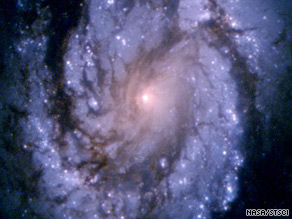 (CNN) -- It may not be possible to travel back in time, but seeing stars and galaxies as they looked millions or even billions of years ago is no problem thanks to telescopes, the closest thing we have to time machines.
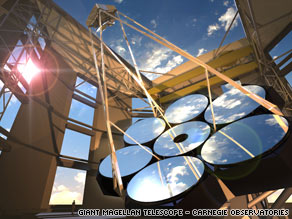 Peering ever deeper into space and further back in time, the powerful devices will be able to show what the universe was like when it was just a few hundred million years old and emerging from a period of total darkness after the Big Bang.
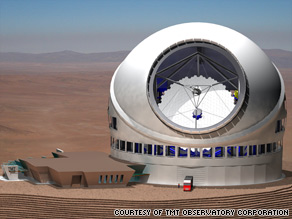 Bigger is better in the world of reflecting telescopes, which rely on primary mirrors to collect light. The bigger the primary mirror, the more light it can gather and the fainter the objects astronomers can see.


