Showing posts with label washington d.c.. Show all posts

Saturday, June 30, 2012

Eastern US Storms Kill 13, Cut Power to Millions


WASHINGTON (AP) — Millions across the mid-Atlantic region sweltered Saturday in the aftermath of violent storms that pummeled the eastern U.S. with high winds and downed trees, killing at least 13 people and leaving 3 million without power during a heat wave.

Power officials said the outages wouldn't be repaired for several days to a week, likening the damage to a serious hurricane. Emergencies were declared in Maryland, West Virginia, Ohio, the District of Columbia and Virginia, where Gov. Bob McDonnell said the state had its largest non-hurricane outage in history, as more storms threatened. "This is a very dangerous situation," the governor said.

In West Virginia, 232 Amtrak passengers spent Friday night on a train that was blocked on both sides by trees that fell on the tracks, and they were waiting for buses to pick them up Saturday. And in Illinois, storm damage forced the transfer of dozens of maximum-security, mentally ill prisoners from one prison to another.

In some Virginia suburbs of Washington, emergency 911 call centers were out of service; residents were told to call local police and fire departments. Huge trees fell across streets in Washington, leaving cars crunched up next to them, and onto the fairway at the AT&T National golf tournament in Maryland. Cell phone and Internet service was spotty, gas stations shut down and residents were urged to conserve water until sewage plants returned to power.

The outages were especially dangerous because they left the region without air conditioning in an oppressive heat. Temperatures soared to highs in the mid-90s in Baltimore and Washington, where it had hit 104 on Friday.

"I've called everybody except for the state police to try to get power going," said Karen Fryer, resident services director at two assisted living facilities in Washington. The facilities had generator power, but needed to go out for portable air conditioning units, and Fryer worried about a few of her 100 residents who needed backup power for portable oxygen.

On Saturday night, the train passengers stranded near rural Prince, W.Va., were waiting for buses to pick them up after they got stuck at 11 p.m. the previous evening, said Amtrak spokesman Steve Kulm. Kulm said the train bound from New York to Chicago has power, so lights and air conditioning are working. He says that since it's a long-distance train, it was stocked with food and crew members were able to get to town to buy more.

Kulm says passengers should be on the buses sometime Saturday evening.

About 170 miles to the northeast in Morgantown, W.Va., Jeff and Alice Haney loaded their cart at Lowe's with cases of water, extra flashlights and batteries, and wiring for the generator they hoped would be enough to kick-start their air conditioner. Even if they had to live without cool air, the family had a backup plan.

"We have a pool," Jeff Haney said, "so we'll be OK."

The storm did damage from Indiana to New Jersey, although the bulk of it was in West Virginia, Washington and suburban Virginia and Maryland. At least six of the dead were killed in Virginia, including a 90-year-old woman asleep in bed when a tree slammed into her home. Two young cousins in New Jersey were killed when a tree fell on their tent while camping. Two were killed in Maryland, one in Ohio, one in Kentucky and one in Washington.

Illinois corrections officials transferred 78 inmates from a prison in Dixon to the Pontiac Correctional Center after storms Friday night caused significant damage, Department of Corrections spokeswoman Stacey Solano said.

No one was injured, Solano said. Generators are providing power to the prison, which is locked down, confining remaining inmates to their cells.

Utility officials said it could take at least several days to restore power to all customers because of the sheer magnitude of the outages and the destruction. Winds and toppled trees brought down entire power lines, and debris has to be cleared from power stations and other structures. All of that takes time and can't be accomplished with the flip of a switch.

"This is very unfortunate timing," said Myra Oppel, a spokeswoman for Pepco, which reported over 400,000 outages in Washington and its suburbs. "We do understand the hardship that this brings, especially with the heat as intense at is. We will be working around the clock until we get the last customer on."

Especially at risk were children, the sick and the elderly. In Charleston, W.Va., firefighters helped several people using walkers and wheelchairs get to emergency shelters. One of them, David Gunnoe, uses a wheelchair and had to spend the night in the community room of his apartment complex because the power — and his elevator — went out. Rescuers went up five floors to retrieve his medication.

Gunnoe said he was grateful for the air conditioning, but hoped power would be restored so he could go home.

"It doesn't matter if it's under a rock some place. When you get used to a place, it's home," he said.

More than 20 elderly residents at an apartment home in Indianapolis were displaced when the facility lost power due to a downed tree. Most were bused to a Red Cross facility to spend the night, and others who depend on oxygen assistance were given other accommodations, the fire department said.

Others sought refuge in shopping malls, movie theaters and other places where the air conditioning would be turned to "high."

In Richmond, Va., Tracey Phalen relaxed with her teenage son under the shade of a coffee-house umbrella rather than suffer through the stifling heat of her house, which lost power.

"We'll probably go to a movie theater at the top of the day," she said.

Phalen said Hurricane Irene left her home dark for six days last summer, "and this is reminiscent of that," she said.

Others scheduled impromptu "staycations" or took shelter with friends and relatives.

Robert Clements, 28, said he showered by flashlight on Friday night after power went out at his home in Fairfax, Va. The apartment complex where he lives told his fiancee that power wouldn't be back on for at least two days, and she booked a hotel on Saturday.

Clements' fiancee, 27-year-old Ann Marie Tropiano, said she tried to go to the pool, but it was closed because there was no electricity so the pumps weren't working. She figured the electricity would eventually come back on, but she awoke to find her thermostat reading 81 degrees and slowly climbing. Closing the blinds and curtains didn't help.

"It feels like an oven," she said.

At the AT&T National in Bethesda, Md., trees cracked at their trunks crashed onto the 14th hole and onto ropes that had lined the fairways. The third round of play was suspended for several hours Saturday and was closed to volunteers and spectators. Mark Russell, the PGA Tour's vice president of rules and competition, couldn't remember another time that a tour event was closed to fans.

"It's too dangerous out here," Russell said. "There's a lot of huge limbs. There's a lot of debris. It's like a tornado came through here. It's just not safe."

The outages disrupted service for many subscribers to Netflix, Instagram and Pinterest when the storm cut power to some of Amazon Inc.'s operations. The video and photo sharing services took to Twitter and Facebook to update subscribers on the outages. Netflix and Pinterest had restored service by Saturday afternoon.

The storm that whipped through the region Friday night was called a derecho (duh-RAY'-choh) , a straight line wind storm that sweeps over a large area at high speed. It can produce tornado-like damage. The storm, which can pack wind gusts of up to 90 mph, began in the Midwest, passed over the Appalachian Mountains and then drew new strength from a high pressure system as it hit the southeastern U.S., said Bryan Jackson, a meteorologist with the National Weather Service.

"It's one of those storms," Jackson said. "It just plows through."


Thursday, June 14, 2012

Military Drone Mistaken for UFO on D.C.’s Capital Beltway

Yahoo- Some folks in the Washington, D.C., area are buzzing about what they thought was a UFO atop a flatbed truck on the Capitol Beltway.


Turns out the disc-shaped object was just a run-of-the-mill military drone.


MyFoxDC reports that what drivers saw—and some photographed—around 11 p.m. Wednesday on Interstate 270, and then later on Interstate 495, was an X-47B Unmanned Combat Air System being transported from Edwards Air Force Base in California to the Naval Air Station Patuxent River in Maryland for testing.


During its travels through the D.C. area, local station WTOP reported a flurry of activity on Twitter about the strange-looking object.


This not the first time a drone was mistaken for something alien. Last year, a drone being transported by flatbed to Pax River for practicing aircraft carrier takeoffs and landings was also mistaken for a UFO, the Daily Caller reported.


Monday, September 12, 2011

This Day In History


Sep 12 1992
Anthony Perkins, star of the Hitchcock classic Psycho, dies of AIDS in his Hollywood hills home. His extraordinary versatility as an actor is captured in the films Psycho II, Psycho III, and Psycho IV: The New Beginning.


Sep 12 1994
After a night of boozing and smoking crack, Frank Corder steals a Cessna P150 and crashes it into the south lawn of the White House. The wreckage tumbles over a tree and a hedge before coming to rest against the West Wing of the Executive Mansion. Corder's flamboyant suicide attack never actually imperiled President Clinton's life, since the First Family was sleeping elsewhere at the time.

Wednesday, August 24, 2011

This Day In History


Aug 24 1812
The White House and other public buildings in the District of Columbia are torched by the British.


Aug 24 1981
Mark David Chapman sentenced to 20 years for killing Beatle John Lennon.

Tuesday, July 19, 2011

This Day In History


Jul 19 1692
Five Salem witches are hanged for the crime of witchcraft, based primarily on the accusations of little girls who were bewitched. Eventually, the village executes a total of 20 witches.


Jul 19 1952
During a series of UFO sightings in Washington, D.C. occurring over July 13-29, unidentified objects are picked up on D.C.'s National Airport radar system. Sightings in the region are so extensive the Air Force is prompted to hold a press conference. Conveniently, these are all "radar mirages" resulting from "temperature inversions."


Jul 19 1966
Frank Sinatra marries Mia Farrow in Las Vegas. Ava Gardner's famous comment on the union: "Hah! I always knew Frank would end up in bed with a little boy!"


Jul 19 1991
Heavyweight boxer Mike Tyson rapes Desiree Washington, one of the Miss Black America contestants, after a pageant rehearsal. The illicit nookie lands Tyson in prison for three years.

Saturday, October 23, 2010

Trial May Start Monday in Chandra Levy Murder Case

Washington (CNN) -- A jury was seated Friday in the trial of a man charged with the 2001 murder of Chandra Levy.

Prosecutors, defense attorneys and the judge picked 12 women and four men -- four of the 16 are alternates -- to serve on the panel. The trial is expected to start Monday.

Levy's disappearance nine years ago received widespread publicity because of her relationship with a congressman. The revelation contributed to the political downfall of California Democrat Gary Condit, who now may be called to the witness stand.

Police said Condit was never a suspect in the case, although he was questioned intensively as investigators tried to find Levy, who vanished at the end of her federal internship at the U.S. Bureau of Prisons.

The man accused of her murder, Ingmar Guandique, is a reputed member of the Salvadoran gang Mara Salvatrucha. Authorities believe that he attacked Levy, 24, as she jogged in a park, killing her when she began to scream.

Her remains were found more than a year later in a wooded area of D.C.'s Rock Creek Park.

Guandique was sentenced in 2002 for attacking two other women in the same park. Years later, officials say, he admitted to fellow inmates that he had killed Levy.

Defense attorneys have questioned the police investigation and, this week, wondered about a second man named in a FBI fingerprint memo prosecutors had just disclosed to Guandique's counsel.

In that memo, both Guandique and the other man were cleared of any match in fingerprints lifted from a vehicle parked near the crime scene.

Guandique denies that he committed the crime, and there is no physical evidence linking him to it, leaving prosecutors to base their case largely on his alleged jailhouse admission that he killed the young intern.

The judge in the case struck a number of potential jurors this week without further questioning. They provided unacceptable answers on a 55-question survey the pool filled out Monday. Others were called in to further explain certain responses that could affect their ability to render a fair verdict.

The judge's instructions and opening presentations in the trial are expected to begin Monday.

Sunday, October 17, 2010

Chandra Levy's Family Prepares for Trial, Not for Closure

MODESTO, CALIF. - The Levys had just finished a family vacation to Hershey, Pa. Robert Levy drove the rental car to Metro Center in the District, kissed his daughter, Chandra, on the head, said goodbye and headed to the airport with his wife.

It was the last time Robert and Susan Levy would ever see their only daughter.

A week later, about May 1, 2001, Chandra went missing. Ever since, Robert Levy has been haunted by a feeling he had that evening, a feeling that he didn't share with anyone.

"Something inside of me knew it was going to be the last time I ever saw her. I just wish I had done something. I wish I had said something," Levy said sitting next to Susan in their ranch-style home in the Central Valley of Northern California.

The disclosure stunned his wife. "What? God damn it. I wish you had said something before now," she said.

Now, nine years after Chandra Levy's disappearance and slaying, as her accused killer is set to stand trial Monday in D.C. Superior Court, the Levy family still can't escape the grief, the nagging feelings, the anger and regret that come with the death of a child.

It was the quintessential Washington story. An energetic, ambitious young college student flies across the country to intern with the government in the nation's capital, a city still innocent of the Sept. 11, 2001, attacks that would come four months later.

With dreams of success, the intern works hard. She also is having an affair with her married hometown congressman. The tale turns tragic.

Chandra Levy, 24, had completed her internship with the Federal Bureau of Prisons and was preparing to return to California for her college graduation. But she never made it out of Washington.

She left her Dupont Circle apartment and never returned. As news of her affair with then-Rep. Gary A. Condit (D) became public, the case of the missing intern became an international media sensation.

Pictures of Levy, with her shy smile and thick, curly brown hair, were aired on newscasts and published in papers across the globe. When she vanished, police questioned Condit, making the story even hotter.

The Levys, perhaps inadvertently, fueled the flames, holding vigils and news conferences, hoping to help find their daughter.

About a year after she disappeared, on May 22, 2002, a man looking for antlers and animal bones with his dog in Rock Creek Park found Chandra Levy's skeletal remains.

---------------

Ingmar Guandique's story is far different from that of a college intern. Guandique, 29, entered the U.S. illegally from El Salvador in 2000 and worked as a day laborer. He is a gang member and is charged with first-degree murder, kidnapping and sexual assault in Levy's death.

Authorities are convinced that Guandique attacked, raped and killed Levy in a secluded area of Rock Creek Park sometime around May 1, 2001.

But when he goes on trial, securing a conviction could be difficult. There is no DNA and no eyewitness.

Prosecutors are pinning their case primarily on statements that Guandique allegedly made to other prisoners and in letters he wrote. Guandique also confessed to assaulting two female joggers in the park about the same time Levy was killed. He was sentenced to 10 years for those attacks and was serving his sentence in a California prison.

The Levys spoke to The Washington Post in the weeks before a Superior Court judge ordered the Levys, attorneys and detectives associated with the trial, not to speak publicly about the case.

Robert Levy, 64, said he is "pretty sure" that authorities have the man responsible for his daughter's killing. And he wants Guandique to pay with his life while he's locked up. "I would prefer someone take care of him in prison," Levy said. "He shouldn't die right way. That would be too easy."

While Robert Levy ponders Guandique's fate, his wife isn't entirely convinced that the accused is guilty. Or whether Condit is entirely innocent, even though authorities say he didn't have anything to do with Chandra Levy's death. "I don't know. There's still a lot of questions that I have, and I don't know if I will ever get answers," she said.

Susan Levy still has a hard time with everything. Her husband can lose himself in 12- and 14-hour days at his oncology practice. Susan Levy, meanwhile, often stays home and admittedly "mopes" while caring for their feisty dachshund, Baba; aging golden retriever, California; and the couple's two horses. Susan also cares for her 93-year-old mother, who recently moved from Florida to a retirement home near them.

Susan Levy, 63, has had trouble with her eyes and one of her knees. The ailments have slowed her down a little as she tries to locate her keys or the pieces of paper that remind her of her husband's cellphone number. She's long given up painting, although numerous pieces of her art adorn their house. "I'm just such a mess," she said, laughing.

Having so much time and living with the "trauma," as she calls it, Levy often ponders theories of what led to her daughter's death. "Was she in the wrong place at the wrong time? Or it could have been because of who she knew? I don't know," she said.


Susan Levy met Condit one time, just after their daughter disappeared. "He wasn't anything like I thought. I wasn't impressed. I don't know what she was thinking," Susan Levy said with a slight laugh.

When Susan Levy does leave the house, she can often be found at functions, mostly on the West Coast, for families of missing and slain children.

Recently, Levy and her friend Boni Driskill rallied in Sacramento for families of missing and slain children. Driskill's adult daughter Laci was fatally shot in 2003 when she was accidentally caught in a drive-by shooting. The women formed a nonprofit support group, Wings of Protection.

"She's a strong woman, but as this trial gets closer and closer, it has become more difficult for her to cope, it seems," Driskill said of Susan Levy.

Although the Levys were regulars on dozens of talk shows, including "The Oprah Winfrey Show" and "Larry King Live," after their daughter went missing, the years have caused some to forget Susan Levy's face. But when she tells people her daughter's name was Chandra, the handshakes turn into hugs. It's that East Indian name that means "higher than the stars and the moon" that people remember, she said.

At the Sacramento rally, Jannel Rap of Lincoln, Neb., asked Levy for advice on getting media attention for her sister who went missing 10 years ago. Rap said media outlets refused to carry her story because her 40-year-old sister "was not associated with a scandal or connected to a famous person," Rap said.

Meeting so many grieving family members and seeing pictures of missing or slain children has taken its toll on Levy. She doesn't attend nearly as many rallies as she used to.

"This is a lot of pain. It's painful to see these children, but we have to make a difference," Levy said. "I just want to feel like we made a difference in our child's name."

'It doesn't go away'


Back home, Robert Levy said he doesn't plan to attend the trial and "sit around and be aggravated by the thing."

But Susan Levy plans on being there. "As the mother, as all mothers in most cases, we do show up for the trials for our loved ones," she said. "I gave birth to her. . . . I have to be her voice now. I have to hear what they will be saying about her."

Still, even if the jury finds Guandique guilty, it will not bring closure. Closure, they say, is when a company goes out of business or when a building is boarded up. A parent, they say, never stops grieving for their child.

The Levys said their daughter's slaying has affected all aspects of their life. Relationships with longtime friends have changed, largely because their friends are becoming grandparents. And although they still have Chandra's brother, Adam, 29, an animator who lives in the Boston area, they grieve at not being able to watch their daughter mature, get married and have children.

Robert Levy continues to search for signs that he believes Chandra sends from heaven: The picture of Chandra that recently fell out of a storage bin and landed at his feet, for example.

And he continues to wonder about what might have happened if he had done something different, anything, after watching his daughter walk into the Metro station nine years ago. "It doesn't go away," he said.

Wednesday, February 10, 2010

Enough Already: Snow Breaks Mid-Atlantic Records


WASHINGTON – Worst winter ever? The second blizzard in less than a week buried the most populous stretch of the East Coast under nearly a foot of snow Wednesday, breaking records for the snowiest winter and demoralizing millions of people still trying to dig out from the previous storm.

Conditions in the nation's capital were so bad that even plows were advised to get off the roads, and forecasters were eyeing a third storm that could be brewing for next week.

For many families, the first storm was a fun weekend diversion. People even went skiing past Washington's monuments. But Wednesday's blizzard quickly became a serious safety concern. The Pennsylvania governor shut down some highways and warned that people who drove were risking their lives.

"I've seen enough," said Bill Daly, 57, as gusts of wind and snow lashed his face in Arlington, Va., where streets were nearly empty just a few days after people had been playing in the snow.

"It's scary and beautiful at the same time. I wanted to shovel but thought if I had a heart attack it could be a while before anybody found me in this kind of weather."

Old-timers talk about a storm that blew through Washington in 1922, collapsing the roof on the Knickerbocker theater and killing more than 90 people. Their great-great-grandchildren will be able to describe the back-to-back blizzards of 2010, which were not nearly as deadly but set records for the snowiest winters ever in Washington, Baltimore and Philadelphia.

Up to 16 inches fell in parts of western Maryland. Reagan National Airport outside Washington had nearly 10 inches by 2 p.m., and Baltimore got nearly a foot. That was on top of totals up to 3 feet in some places from the weekend storm.

"I have never in my lifetime seen or heard anything quite like this," said D.C. Fire Chief Dennis L. Rubin, who was born and raised in the District.

The previous records for snowiest winters were 62.5 inches in Baltimore in 1995-96; 54.4 inches in Washington in 1898-99; and 65.5 inches in Philadelphia in 1995-96.

On Wednesday, Baltimore had 72.3 inches so far this winter, the Washington area had 54.9 inches and Philadelphia had 70.3 inches.

Heavy snow also fell in New York and New Jersey. Airlines canceled hundreds of flights, and New York City's 1.1 million schoolchildren enjoyed only their third snow day in six years. The Washington area's two airports had no flights coming or going Wednesday.

The streets of downtown Philadelphia were nearly vacant as people heeded the mayor's advice to stay home.

Entrance ramps to closed highways were blockaded, and the Pennsylvania National Guard had Humvees stocked with food and blankets ready to help anyone who got stuck. Earlier in the day, about 25 vehicles were involved in two separate pileups on snowy Interstate 80 in central Pennsylvania. One man was killed and 18 people injured.

"For your safety, do not drive," Gov. Ed Rendell said. "You will risk your life and, potentially, the lives of others if you get stuck on highways or any road."

Two other people were killed when their snowmobile struck a moving vehicle at an intersection in Lancaster, Pa. Michigan authorities said the storm contributed to at least four traffic deaths there.

In Virginia, where some areas had snow totals exceeding 30 inches from the two storms, winds were howling at 50 mph and temperatures were plunging. Gov. Bob McDonnell urged people to stay indoors.

"This snow reminds me of when I was driving tractor-trailers in Saudi Arabia, and the sandstorm starts and you can't see the roads," said Syeed Zada, 55, a plow driver for the Virginia Department of Transportation.

More than 100,000 utility customers in Pennsylvania were without power. Some never got it back after the last storm.

Glenn Harvey, 59, who has a lung problem and needs oxygen, had been staying at a Red Cross shelter in Bentleyville, Pa., since Saturday.

Firefighters brought him there after the storm knocked out power to his house Friday night. His wife stayed home with their dog, where she's using a kerosene heater to keep warm.

"It's not been easy on her," Harvey said.

In Washington, officials announced that federal agencies would stay closed for a fourth straight day Thursday. The longest weather-related government shutdown ever was in 1996, when employees did not have to go to work for a full week.

A Caribou Coffee shop in the capital was standing room only. Most people pecked away at laptop computers as snow fell steadily outside.

"Can't get to the office, but the work still needs to get done," said attorney Christopher Erckert.

Driving conditions got so bad that officials in Washington and some nearby suburbs pulled plows off the roads. In Baltimore, Pete Korfiatis dumped snow into the Inner Harbor with a front-end loader until city officials decided the roads were too slick.

"They just shut everything down," he said.

Heavy snow collapsed part of the roof and a wall at a Smithsonian Institution storage building in Suitland, Md. It was not clear if any artifacts were damaged.

The District of Columbia's representative in Congress asked the White House to declare a federal emergency to help the capital recover.

In New York, George and Natividad Sanchez trudged over slushy sidewalks in boots, parkas and scarves to take their 2-year-old daughter to see "Sesame Street Live: When Elmo Grows Up."

"I didn't want to disappoint her," George Sanchez said as the family arrived for the show at a theater in Madison Square Garden.

The news wasn't all bad. Washington has not had a homicide in a week. Ski areas were doing brisk business, when people could get to them. And private contractors were making money plowing driveways and parking lots.

But many people were just ready for the ordeal to end.

In a yard in Westmont, N.J., someone used bright orange paint to scrawl nature a message on a white backdrop: "Dear Mr Frost," it read. "We're good w/ snow."

Friday, September 11, 2009

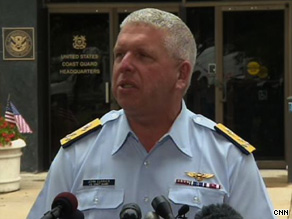
Coast Guard to Review Exercise After Potomac Security Scare

WASHINGTON (CNN) -- The U.S. Coast Guard promised a "thorough review" after a training incident Friday along the Potomac River briefly triggered concerns about the security of President Obama on the eighth anniversary of the September 11 attacks.

The Coast Guard will "take a good, hard look" at how it handled the routine training exercise to determine if the security scare that followed could have been avoided, Vice Adm. John Currier said.

Federal agency emergency operations centers were not aware of or notified about the exercise on the Potomac, and they began implementing response procedures, a federal source said.

Even the police department's Harbor Patrol, which is responsible for patrolling the Potomac, was not notified, law enforcement sources in Washington said.

The patrol has now demanded the Coast Guard notify it in the future before any training exercises on the Potomac, the sources said.

The Coast Guard did not alert other agencies when it conducted the exercise, Currier said.

He said the U.S. Secret Service, which protects the president, was not notified, stressing that the exercise was routine and happens four times a week.

The training incident took place as Obama was traveling across the Memorial Bridge following an event at the Pentagon shortly before 10 a.m. ET. CNN personnel saw what appeared to be a Coast Guard vessel working to prevent a boat from trying to enter a security zone.

Minutes later, there were reports on police scanners that the Coast Guard fired 10 rounds of ammunition.

A Department of Homeland Security representative later said no shots of any kind had been fired.

"Reports in the media were based on overheard radio calls made over a training frequency," the Coast Guard said in its statement.

The Secret Service said Obama was back at the White House by the time reports surfaced of shots being fired.

The Federal Aviation Administration put a "ground halt" on a small number of flights Friday at Reagan National Airport after the security scare, Currier said.

Reagan National is near where the training activity occurred.

Monday, June 22, 2009

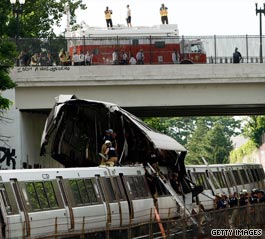
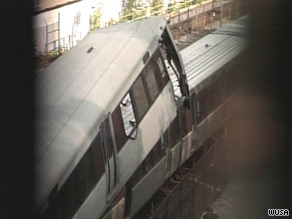
Six Killed in Washington-Area Metro Train Collision

WASHINGTON (CNN) -- A rush-hour collision Monday between two Metro trains north of downtown Washington, D.C., killed at least six people and injured scores, Mayor Adrian Fenty said.

He called it the deadliest crash in the history of the Washington Metropolitan Area Transit Authority, known as Metro. One of the dead was the female operator of one of the trains, Metro officials said.

Some three hours after the accident, fire department sources said rescue operations had ceased, with ongoing work focusing on recovery. Officials believed there were two more bodies to be extricated, in addition to the four dead already removed, the sources said.

The crash happened just before 5 p.m. on an above-ground track on the Red Line in the District of Columbia near the border with Takoma Park, Maryland.

Seventy people were treated at the scene -- 56 with minor injuries, 12 with moderate injuries and two with life-threatening injuries, according to Chief Dennis Rubin of Washington's Fire and Emergency Medical Services Department.

Both trains were on the same track, and one of them was stationary when the crash happened, said John Catoe, Metro general manager.

Video footage of the scene showed two cars of one train lying atop the cars of another train. Emergency personnel carried injured passengers, some on stretchers, from the wreckage.

"Metro officials do not know the cause of the collision and are not likely to know the cause for several days as the investigation unfolds," a Metro statement said.

Fire department personnel cut through the trains to help people from the wreckage, officials said at a press briefing.

Jodie Wickett, a nurse who was a passenger on one of the trains, said she was was texting on her phone when she felt a bump.

"About 5-10 seconds later, the train came to a complete halt -- we went flying," Jodie Wickett said.

She said she went through some of the cars, trying to help people.

"There was debris and people pinned underneath," she said.

Ten to 15 minutes passed before she saw emergency personnel, she said.

Groups of people wearing green plastic ribbons to show they had been checked by paramedics left the scene about 90 minutes after the crash. Some were crying, and a woman with her arm in a sling who gave her name as Tijuana described the crash as "an earthquake."

The National Transportation Safety Board will investigate the crash, NTSB spokeswoman Bridget Serchak said.

At least two FBI officials were at the scene, and the FBI confirmed it was assisting as part of the National Capital Response Squad.

Amy Kudwa of the Department of Homeland Security said "at this early stage," there was no indication of anything other than an accidental collision.

"We will continue to monitor closely and provide support in any way needed," Kudwa said.

It was the second Metro crash to involve fatalities in the 33-year history of the transit authority. In January 1982, a derailment killed three people. The only other collision between Metro trains occurred in 2004.

"We are extremely saddened that there are fatalities as a result of this accident, which has touched our Metro family," Catoe said in a statement.

"Our safety officials are investigating, and will continue to investigate until we determine why this happened and what must be done to ensure it never happens again."

Wednesday, June 17, 2009

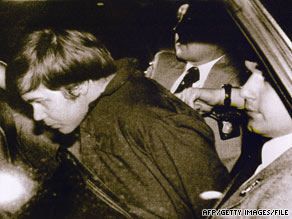
Court Gives Would-Be Assassin John Hinckley More Freedom

WASHINGTON (CNN) -- The man who tried to kill President Ronald Reagan is now allowed to visit his mother more, to get a driver's license and spend more time away from the mental hospital where he lives, a federal judge ruled.

The ruling, released Tuesday, expands the freedoms of John Hinckley Jr. over the objections of prosecutors. They argued that Hinckley is still mentally ill and harbors unhealthy feelings about women.

Hinckley, 54, has been confined to St. Elizabeth's Hospital in Washington since he was found not guilty by reason of insanity in the 1981 shooting of Reagan.

Hinckley shot Reagan and wounded three others reportedly because of an obsession with actress Jodie Foster.

Gradually, Hinckley has been allowed more freedom as he has progressed in therapy.

Recently, family members and hospital officials requested that he be allowed to visit his mother's home in Williamsburg, Virginia, for nine nights instead of the six he was allowed; to get a driver's license; and to do volunteer work, according to court documents. There also was a request for Hinckley to have more unsupervised time away from the hospital.

Prosecutors objected to many of the requests, saying that Hinckley "continues to maintain inappropriate thoughts of violence," court documents said.

Hospital officials asked him to keep a journal of his recent relationships with women, and some of those relationships alarmed prosecutors.

Prosecutors said Hinckley has been having sex with at least two women -- one who is bi-polar and the other who is in a long-term relationship with someone else. At the same time, Hinckley has been dating two other women.

His relationships could cause an "increased risk for violence due to depression or due to a request to act out to demonstrate his love for a woman," prosecutors argued.

Also troubling was a song that Hinckley recently recorded, called "Ballad of an Outlaw," prosecutors said. They described the song as "reflecting suicide and lawlessness."

Hinckley wrote it before his assassination attempt and recently re-recorded it. Hospital officials said he was trying to take responsibility for his past by recording the song again.

In the ruling, Judge Paul L. Friedman of the U.S. District Court in Washington sided with hospital officials and expanded many of Hinckley's freedoms, saying:

"Hinckley will not be a danger to himself or to others under the conditions proposed by the hospital."

Thursday, June 11, 2009

Holocaust Museum Closed in Tribute to Slain Guard

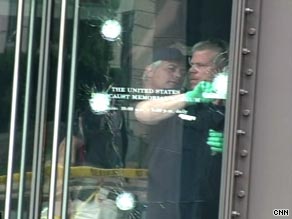
WASHINGTON (CNN) -- The U.S. Holocaust Memorial Museum remained closed Thursday, its flags lowered to half-staff in tribute to a security guard gunned down by a man authorities identified as a rifle-wielding white supremacist.

Later in the morning, the Metropolitan Police Department; the D.C. office of the FBI; the U.S. attorney's office and other federal and local officials will hold a news conference to discuss charges against the accused gunman, 88-year-old James von Brunn of Maryland.

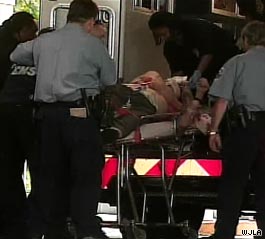
The gunman entered Washington's crowded and solemn Holocaust museum on Wednesday afternoon and shot security officer Stephen Tyrone Johns. Other guards then shot and wounded the gunman, authorities said.

A six-year veteran of the museum's security staff, Johns later "died heroically in the line of duty," said Sara Bloomfield, director of the museum.

"Our thoughts and prayers go out to Officer Johns' family," the museum said.

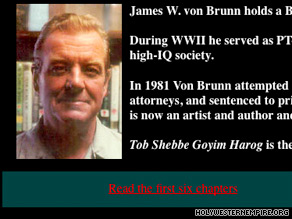
Von Brunn is a Holocaust denier, well-known to human rights groups for decades, who created an anti-Semitic Web site called "The Holy Western Empire." The Southern Poverty Law Center, which focuses on human rights, said von Brunn has "an extremely long history with neo-Nazis and white supremacists."

He has repeatedly claimed "The Diary of Anne Frank," an iconic diary written by a teenage girl who was hiding from Nazis with her family, was a hoax. The guard died on the day the museum was to stage a play based on Anne Frank and two days before what would have been her 80th birthday.

Investigators found a notebook in the suspect's car listing other locations in Washington that he might have considered as targets, a federal official told CNN.

Von Brunn entered the United States Holocaust Memorial Museum at 12:50 p.m. Wednesday and immediately shot Johns with a rifle, said Chief Cathy Lanier of the District of Columbia's Metropolitan Police Department. Two other security guards returned fire, according to Lanier and the museum statement.

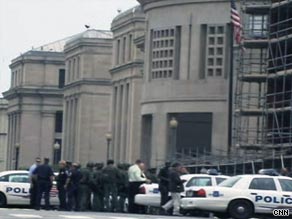
Sirens blared as emergency vehicles converged on the area, which is near the Washington Monument and other popular tourist attractions. The museum was full at the time, with a "couple of thousand" people inside, said William Parsons, chief of staff at the museum.

Von Brunn served six years in prison for trying in 1981 to kidnap Federal Reserve Board members because of high interest rates. He blamed his prison term on a "Negro jury, Jew/Negro attorneys" and "a Jew judge," he said on his Web site, "Holy Western Empire."

One of many questions is whether von Brunn, as a convicted felon, should have turned in his weapons or been barred from owning them.

The U.S. Park Police has asked the Bureau of Alcohol, Tobacco, Firearms and Explosives to trace the firearm, an effort that is expected to provide its original sale and ownership.

An FBI official said there was no warning or threat against the museum.

Both Johns and von Brunn were taken to George Washington University Hospital, said D.C. Mayor Adrian Fenty. Johns died at the hospital. Von Brunn was in critical condition, Fenty said.

Johns, 40, was a resident of Temple Hills, Maryland, according to a statement issued by Wackenhut Services Inc., which has provided security services at the museum since 2002.

"Obviously there are no words to express our grief and shock over the horrific event that took place at this museum today," Bloomfield, the museum director, said.

The Southern Poverty Law Center, which tracks hate groups, said von Brunn has "an extremely long history with neo-Nazis and white supremacists."

Witnesses to the shooting described blood on the floor and chaos within the museum's halls.

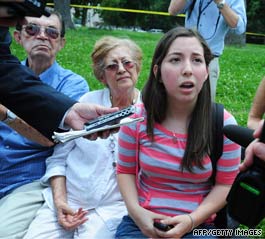
Visitor Maria Hernandez told CNN she heard five shots and saw the wounded security guard.

"It was definitely a security guard; he was down bleeding on the floor," said Hernandez, 19. "He was face down. His back ... blood was coming out."

Sirens blared as emergency vehicles converged on the area, which is near the Washington Monument and other popular tourist attractions. The museum was full at the time, with a "couple of thousand" people inside, said William Parsons, chief of staff at the museum.

"Never take your guard force and security people for granted," he said. "They did exactly what they were supposed to do to protect people in the museum."

Dave Pearson, a sixth-grade teacher in the Washington area, said he was on the museum's fourth floor when he heard a loud noise.

"At the time, we're visiting and all of a sudden there's like a boom, and all of a sudden they told us to stop where we're at," he told CNN. "Only thing we heard was a boom, and that was it."

The shooting sent shock waves throughout the nation's capital and elsewhere.

"I am shocked and saddened by today's shooting at the U.S. Holocaust Memorial Museum," said President Obama, who just days earlier had spoken emotionally about the Holocaust when he visited Buchenwald, a former Nazi concentration camp with Holocaust survivor and Nobel Peace Prize laureate Elie Wiesel.

"This outrageous act reminds us that we must remain vigilant against anti-Semitism and prejudice in all its forms," Obama said Wednesday. "No American institution is more important to this effort than the Holocaust museum, and no act of violence will diminish our determination to honor those who were lost by building a more peaceful and tolerant world."

Israel issued a statement through its embassy, expressing sadness and condemning the attack.

The Anti-Defamation League said the shooting "reminds us in the starkest way where the spread of hatred can lead."

Happening "at the very place that was created to remember and teach about evil in the world," the attack "is an immediate reminder that words of hate matter, that we can never afford to ignore hate because words of hate can easily become acts of hate, no matter the place, no matter the age of the hatemonger."

The Council on American-Islamic Relations condemned "this apparent bias-motivated attack" and said it stands "with the Jewish community and with Americans of all faiths in repudiating the kind of hatred and intolerance that can lead to such disturbing incidents."

The museum canceled a performance scheduled for Wednesday night of a play about racism and anti-Semitism, based on a fictional meeting between Anne Frank and Emmett Till, the teenage victim of a racist killing in the United States.

Attorney General Eric Holder and Rep. Steve Cohen, D-Tennessee, were among those planning to attend the play, which was written by Janet Langhart Cohen, the wife of former Defense Secretary and U.S. Sen. William Cohen.

Langhart Cohen told CNN that Anne Frank's young life was ended by people filled with hate. She said it was hard to see that same hate manifest itself at this place of remembrance.

Wednesday, June 10, 2009

Museum Witness: 'There Was Blood Everywhere'


WASHINGTON (CNN) -- All 19-year-old Maria Hernandez wanted to do was escort her grandparents, visiting from Puerto Rico, through a museum whose displays had so impressed her during her previous visit.

But their tour of the U.S. Holocaust Memorial Museum ended abruptly just before 1 p.m. Tuesday, as they were on the second floor.

"We were in the 'Remember the Children' exhibit. We were just exiting, and we heard shooting," Hernandez said. "I ran towards the glass doors to see what was going on. I thought it was a joke or something."

But it was no joke. She heard security guards yell to someone she could not see: "They were, 'Get on the floor. Drop the weapon! Drop the weapon!' Once he didn't respond, they started shooting."

Hernandez saw another security guard lying flat on his belly. "There was blood everywhere. So I didn't actually see him getting shot, but I saw that he was badly hurt."

As some patrons raced to the apparent safety provided by the exhibit that Hernandez and her grandparents were in, others stopped in their tracks and hit the floor, she said.

"No one was standing up; no one dared move; we were all very scared," she said. "Finally, I ran back towards where my grandparents were to see if they were OK, and there we stayed until further instructions about how to exit the building safely."

When the time came to deliver those instructions, the guards wasted few words: "They were like 'Run! Run!'

By then, Hernandez and her grandparents had separated, and she tried to go back for them but was stopped by the guards. "They were just like, 'Go! We'll take care of it. Just go. Get outta here.' "

She complied. "I just ran from the building as fast as I could. I didn't want to stay to look. I really didn't."

Soon after, she reunited with her grandparents. "They are well, thank God. I was just trying to see where they were and make sure they were OK."

The irony that a museum intended to honor the memories of victims of senseless violence could itself be the site of senseless violence was not lost on Bonnie Gudis, the daughter of a Holocaust survivor whose husband's parents were also Holocaust survivors.

"It was a very emotional day for us," she said. "And for this to happen on top of it was unbelievable."

She said her father had always told her never to forget the Holocaust. "It can happen any time, any place. No matter what the future brings, there's always going to be some crazies who have hatred in their hearts."

Former Defense Secretary William Cohen was at the museum awaiting his wife, whose play about hatred was to have debuted there Wednesday night, when he saw a red car that appeared to have been left double parked in front and an older man entering the building.

Neither image registered as a major concern: "I didn't pay much attention to him. I was on the phone," he said. But Cohen began paying attention seconds later, when he heard gunshots 30 to 40 feet away.

"There was no mistaking on my part," he said. "About four in a row after the first one. It was 'Bam! Bam! Bam! Bam!' and it was clear what was going on."

He ducked out of the line of fire and raced up the museum stairs.

He praised the security guards for what they did next. "They were on that man right away. The security team went into action, and they made sure that all of the people in the museum were safe."

Mark Lippert and his fiancée, Lori Delagarza, had just finished a museum tour and were about to enter the "Remember the Children" exhibit when they heard what he thought were four loud pops.

Delagarza said they sounded like gunshots, Lippert said, but he wasn't convinced. "I said, 'No, it doesn't make sense that it would be.' "

Any doubt ended when he saw three children rushing toward them. "They just had this look on their face; it told me that something was very, very wrong," said the sales manager for a radio station in Oglesby, Illinois. "One of the kids basically did say, 'There's someone with a gun.'

"And it happened so quickly, you're standing there going, 'Really? Is it? You don't know?' And then my mind starts racing, thinking, 'OK, we're in this area, which is small. What if somebody does have a gun and they're coming up to that area? Where are we going to go?' "

Where they went was away from the shooting and farther into the exhibit in search of an emergency exit, which they soon found. "So I pushed the door, and it didn't open, and my first thought was, 'This is really not good.'

"I pushed the door again, and it didn't open, and then I look up, and the sign says you have to hold the bar for 15 seconds for the electronic door to open and let you out.

"And so I'm holding that bar the whole time, and that was like the longest 15 seconds of my life."

Finally, the door opened onto the 15th Street side of the museum to reveal the Washington Monument and police who were waving everyone out of the building, he said.

As museum visitors -- many of them children -- streamed out the doors, some wept, he said.

Lippert said he had chosen the museum as the couple's first place to visit during their trip to Washington.

"I knew it would be very interesting and not just your normal tourist place," he said. "I like history, and I thought it would be very interesting. And it was."

Law center: Shooting suspect has 'long history' with neo-Nazis

WASHINGTON (CNN) -- An 88-year-old Maryland man with a long history of ties to white supremacist groups is the suspect in Wednesday's shooting at the U.S. Holocaust Memorial Museum, two law enforcement officials told CNN.

James von Brunn served six years in prison for trying to make what he called a "legal, non-violent citizens arrest" of Federal Reserve board members in 1981 -- a sentence he blamed on "a Negro jury, Jew/Negro attorneys" and "a Jew judge," he said on his Web site, "Holy Western Empire."

"He is in our files going back way into the 1980s," said Heidi Beirich, a researcher for the Montgomery, Alabama-based Southern Poverty Law Center. "He has an extremely long history with neo-Nazis and white supremacists. He's written extremely incendiary publications raging about Jews, blacks and the like."

Von Brunn is a native of St. Louis, Missouri, and a 1943 graduate of Washington University there. According to his online biography, he served as a Navy officer in World War II and became an advertising artist and executive after the war.

But by the late 1970s, Beirich told CNN, he had become a "hardcore neo-Nazi" and an associate of William Pierce -- the white supremacist leader whose 1978 book, "The Turner Diaries," is blamed for inspiring Oklahoma City bomber Timothy McVeigh.

In December 1981, angered by what he called the "treacherous and unconstitutional" acts of the Federal Reserve, von Brunn entered the central bank's Washington headquarters armed with a pistol, a shotgun, a knife, and a mock bomb, according to court records. He claimed to be a photographer who wanted to shoot pictures of the boardroom, and bolted up the stairs when security guards told him to wait.

While being subdued, he claimed to have planted a bomb, forcing the building's evacuation, court records state. He told officers he was upset over high interest rates -- then well into double digits -- and the state of the economy, which was in a recession.

Von Brunn, then 62, was sentenced to six years in prison on attempted kidnapping, second-degree burglary, assault and weapons charges. In a December 1984 appeal, his attorney, John Hogrogian, asked the court to release the defendant on bail, saying his client had "renounced his actions of December 7, 1981, and expressed remorse in a letter addressed to this court."

Von Brunn has "a young son and aches to see him again," his lawyer wrote.

Von Brunn's trial dealt extensively with his "attitudes about black and Jewish people," which his lawyer said were irrelevant to the charges he was facing.

Documents were read at trial in which von Brunn wrote, "Goal: to deport all Jews and blacks from the white nations," among other racist statements.

In his testimony he also said "the basic plan was to wind up where I am now," meaning in court to raise publicity for his campaign against the Federal Reserve.

His appeal was denied.

Von Brunn's Web site proclaims itself "a new, hard-hitting expose of the Jew conspiracy to destroy the white gene-pool."

Postings attributed to von Brunn have appeared on numerous other sites, including ones that call the Holocaust and "The Diary of Anne Frank" hoaxes and bemoan the decline of the "Aryan gene pool."

"Bit by bit Liberalism ascended. Bit by bit the Constitution was re-interpreted. Bit by bit government institutions and Congressmen fell into JEW hands --then U.S. diplomacy, businesses, resources and manpower came under JEW control," one such message reads. "Whitemen sat on their collective asses and did NOTHING -- NOTHING BUT TALK."

More recently, messages attributed to von Brunn question the authenticity of President Obama's birth certificate, the subject of numerous conspiracy theories. Advocates of those theories imply that Obama was born overseas and therefore would be constitutionally ineligible to hold office.

Von Brunn was in critical condition Wednesday afternoon after being shot by a security guard at the museum. Another guard, Stephen Tyrone Johns, was killed in the shooting, museum officials said Wednesday afternoon.

Washington police and the FBI said the shooting appeared to have been the work of a single gunman and there was no prior indication of the attack.

Tuesday, June 9, 2009

Joe McCain's 911 Call


Time - Apparently miffed at being stuck in traffic, presidential candidate John McCain's younger brother Joe called 911 in the fall of 2008 after getting stuck in traffic near Washington's Wilson Bridge.

When the operator chided him for the decidedly non-emergency call, the younger McCain cursed at him and hung up. His lesson clearly unlearned, McCain later called 911 again, this time to complain about a message left on his voicemail by the first emergency operator.

He later apologized and withdrew from campaign activities. Asked for his brother's response to the brouhaha, Joe McCain said, "He's not going to be happy about it, I'm sure."

Friday, April 24, 2009

This Day In History


Apr 24 1967
Cosmonaut Vladimir Komarov soon becomes the world's first space mission fatality after his Soyuz parachutes become entangled four miles above the Earth.


Apr 24 1995
The Unabomber strikes, killing a timber industry lobbyist. Gilbert Murray is killed in his Sacramento office, opening mail addressed to the man he replaced.


Apr 24 1997
A petri dish arrives in an 8x10 manila envelope at the Washington, D.C. offices of B'nai B'rith International. The dish, labeled "anthracks," drips a liquidy red gel which is later determined to contain a relatively harmless strain of Bacillus cereus.