 (CNN) -- The presence of swine flu in Mexico and the United States is "a serious situation" that could develop into a pandemic, the World Health Organization's director-general said Saturday.
"This is an animal strain of the H1N1 virus and it has pandemic potential because it is infecting people," Dr. Margaret Chan said Saturday speaking to reporters by phone.
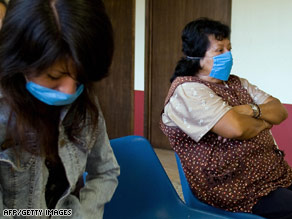
In Mexico, 68 people have died from swine flu, according to a statement from the U.S. Embassy in Mexico.
Eight people were confirmed to have swine flu in the United States; six in California and two in Texas, according to the U.S. Centers for Disease Control and Prevention.
All eight have recovered, according to CDC's acting Director Richard Besser.
Preliminary results from tests of students at a New York school do not rule out swine flu, the director of surveillance for the Bureau of Communicable Diseases said Saturday.
Dr. Don Weiss said the samples will now be sent to the Centers for Disease Control and Prevention. Test results could be known by Sunday.
He said the samples came back positive for "Type A" flu and the tests will need to determine the samples' subtype.
He said up to 100 students at the Queens school reported feeling ill.
CDC has tested 14 samples of the virus from Mexico and found seven were identical to the virus found in the U.S. cases, Besser said.
"This situation has been developing quickly," he said. "This is something we are worried about."
Asked whether the committee would address raising the agency's alert concerning the virus to 6, a pandemic alert and the highest level on WHO's scale, Chan said, "Yes, indeed."
The alert stands at 3, meaning "No or very limited human-to-human transmission."
Chan said Saturday that WHO does not have indications of similar outbreaks elsewhere.
However, she said, "The situation is evolving quickly. A new disease is by definition poorly understood."
White House spokesman Reid Cherlin said Saturday that the White House was taking the situation "seriously and monitoring for any developments."
Health officials in Texas announced Saturday the temporary closure of Byron Steel High School in Cibolo, Texas, where swine flu was confirmed in two students earlier this month.
"The purpose is to reduce the risk to students, staff and the community," said Dr. Sandra Guerra, a public health official in Guadalupe County, Texas.
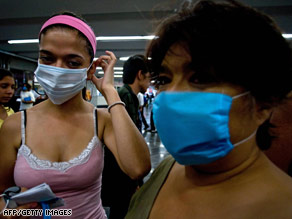
Mexico City has closed all of its schools and universities until further notice because of the virus, and on Saturday, the country's National Health Council said all soccer games would be played Saturday without public audiences.
More than 1,000 people have been sickened in the country, and officials are trying to determine how many of those patients had swine flu, the country's health minister, Jose Angel Cordova Villalobos, said.
None of the U.S. patients had direct contact with pigs, though a patient who lives in San Diego had traveled to Mexico, the CDC said.
Besser said officials had not found common exposure or behavior among the eight U.S. patients.
"We have not seen any linkage at all between the cases in Texas and California," he said.
The new virus has genes from North American swine influenza, avian influenza, human influenza and a form of swine influenza normally found in Asia and Europe, said Nancy Cox, chief of the CDC's Influenza Division.
Swine flu is caused by a virus similar to a type of flu virus that infects people every year but is a strain typically found only in pigs -- or in people who have direct contact with pigs.
There have, however, been cases of person-to-person transmission of swine flu, the CDC said. Officials found evidence, for example, that a patient transmitted the disease to health care workers during a 1988 apparent swine flu infection among pigs in Wisconsin.
Experts think coughing, sneezing and contaminated surfaces spread the infection among people.
The new strain of swine flu has resisted some antiviral drugs, officials said.
The human influenza vaccine's ability to protect against the new swine flu strain is unknown, and studies are ongoing, said Dr. Anne Schuchat, the CDC's interim deputy director for science and public health program. There is no danger of contracting the virus from eating pork products, she said.
Canada is also testing samples from Mexico "and has placed a travel alert for travel to Mexico," CDC spokesman David Daigle told CNN by e-mail.
The United States had not issued any travel alerts or advisories by late Friday, but some private companies issued their own warnings.

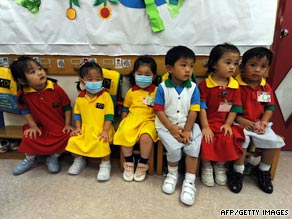 (CNN) -- The World Health Organization raised the swine flu alert Thursday to its highest level, saying H1N1 has spread to enough countries to be considered a global pandemic.


